

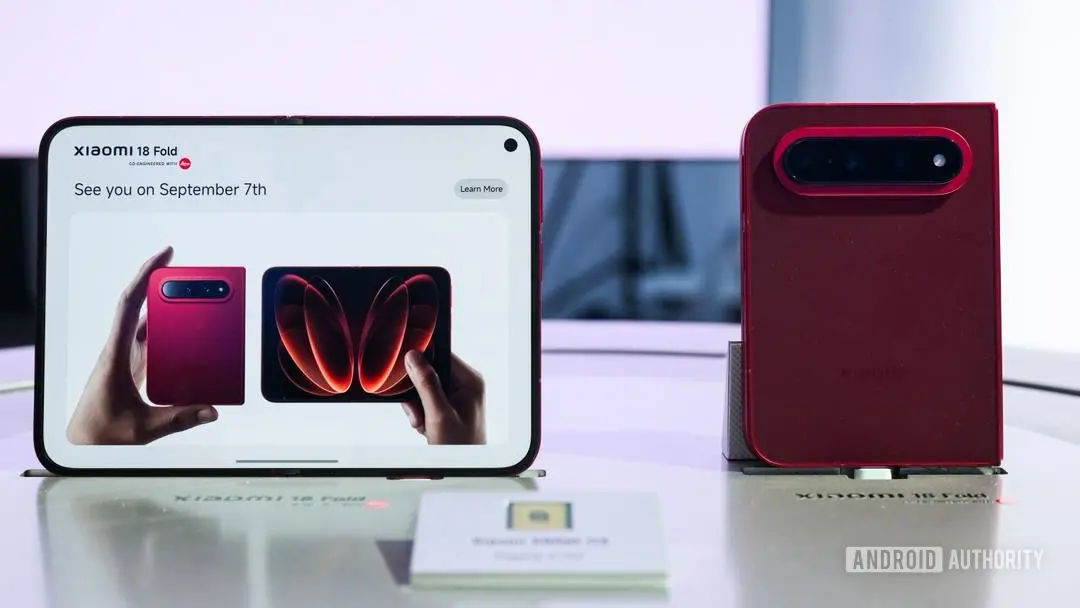
Xiaomi chose the IFA 2026 stage in Berlin to unveil the Xiaomi 18 Fold, giving the public its first official look at a long-rumored wide-screen folding phone. The device is an important milestone not only for the company's foldable lineup but also for its silicon ambitions, as the 18 Fold is the first flagship running on Xiaomi's in-house XRing O3 chip.
The announcement comes after several weeks of leaks, real-world images, and official render drops. At IFA, Xiaomi gave visitors a hands-on look at the cherry red finished device, confirming a wide-folding form factor, a horizontally positioned triple-camera array, and an interesting 17mm to 80mm focal range printed on the rear camera bar. This range points to a possible 3.3x telephoto lens, giving the device a versatile imaging system for a foldable.
The Xiaomi 18 Fold will launch in China on September 7, but the company has not yet revealed full specifications. However, Xiaomi did confirm that the foldable will use ChangXin Memory Technologies' next-generation LPDDR6 RAM with speeds reaching up to 12,800 Mbps, a serious upgrade that should benefit both multi-tasking and on-device AI workloads.
A first official look at the Xiaomi 18 Fold
The Xiaomi booth at IFA 2026 occupies more than 3,300 square meters, making it Xiaomi's largest standalone overseas exhibition to date. The open-floor space covers smartphones, smart home products, electric vehicles, and AI solutions, all linked by the company's "Human x Car x Home" strategy. The centerpiece of the booth is undoubtedly the Xiaomi 18 Fold, which sits alongside more than 380 other products.
Attendees were able to see the wide foldable from every angle, including its cherry red rear panel. This marks a departure from the more restrained colors usually seen on Xiaomi's ultra-premium devices. The bright finish makes the foldable stand out, while the camera bar delivers a more structured design language. The device appears to have a dual-screen setup consistent with other wide foldables, but it distinguishes itself through the integrated XRing O3 chip and the specifically designed LPDDR6 RAM.
The Xiaomi 18 Fold is Xiaomi's first flagship phone to use the company's own processor. This is part of a broader trend among major Chinese smartphone manufacturers, all of whom are trying to reduce their reliance on Qualcomm and MediaTek. Xiaomi had been developing custom silicon for years, and the XRing O3 chip now makes its way into a true high-end device. The chip is expected to handle on-device AI features, advanced image processing, and energy-efficient daily operation. Xiaomi, however, kept many technical details under wraps, leaving the rest of the processing story to be told during the China launch event.
In addition to the new chip, the 18 Fold will use ChangXin Memory's next-generation LPDDR6 RAM. The move toward Chinese memory suppliers is significant, as it shows Xiaomi building a deeper local supply chain that can survive geopolitical disruptions. With memory speed reaching 12,800 Mbps, the device will be well equipped for heavy multitasking, dynamic camera processing, and future AI applications that need high bandwidth.
Camera system and design
According to the official product display, the Xiaomi 18 Fold includes a triple-camera system arranged in a horizontal bar. Xiaomi has not yet confirmed the exact sensor specifications, but the model shown at IFA includes the 17mm to 80mm focal range printed on the module. As a result, industry observers expect a wide primary camera, an ultra-wide camera of about 17mm, and a telephoto lens of about 80mm equivalent. That indicates a roughly 3.3x optical zoom, which is increasingly common among premium foldables.
The wide-folding design places the display in a squarer, notebook-like orientation when opened. This is a clear response to the growing demand for a foldable that behaves much more like a small tablet. Xiaomi has already experimented with wide foldables in the past, but the 18 Fold refines the approach with a larger cover display, a redesigned hinge system, and a distinctive color option.
The device also bears visual similarities to Huawei's wide-screen Pura X Max, which was also shown to the public in 2026. This suggests that the market for wide foldables is rapidly expanding. Xiaomi is not the only company turning to this format, but it is leveraging its own chip and memory confidence to differentiates the phone in a competitive segment.
The timing of the debut
Xiaomi's unveiling at IFA 2026 is not happening in a vacuum. The Xiaomi 18 Fold arrives right after Samsung introduced its first wide-screen foldable, the Galaxy Z Fold 8, and just before Apple is expected to introduce its own folding iPhone. Apple's device is also rumored to adopt a wide-folding design. That means the battle for the future of premium foldables is now centered around a similar physical form factor, with differentiation occurring through software, silicon, and ecosystem integration.
Samsung was the original pioneer of the modern foldable category, but its recent shift toward a wider cover display validates a format that Xiaomi and Huawei have promoted more aggressively in the Chinese market. At the same time, Apple's entrance into the foldable space threatens to reshape consumer expectations overnight. Xiaomi's decision to debut the 18 Fold at IFA, a major European trade show, signals its intention to grow beyond Asia and compete in Western markets.
The IFA 2026 timing also aligns with Xiaomi's global expansion strategy. In recent years, Xiaomi has transformed itself from a smartphone brand into a diversified technology ecosystem, with products ranging from electric scooters to Mijia smart appliances and, most notably, its SU7 electric car. The "Human x Car x Home" slogan is meant to convey that all of these devices work together seamlessly, and the 18 Fold is positioned as a central hub for this connected ecosystem.
More than 380 products on display
While the 18 Fold is the headline product, Xiaomi has much more to show at IFA 2026. The company is making its official IFA debut with an enormous exhibition that includes more than 380 products. These include smartphones, wearables, tablets, laptops, smart home devices, and a range of AI-powered tools. Xiaomi also brought its Mijia smart home brand to Europe, marking the European expansion of a product line that has already become extremely popular in China.
Visitors to the Xiaomi booth can explore smart displays, robotic vacuum cleaners, smart lighting systems, security cameras, and several products designed to connect with Xiaomi's mobility portfolio. The overall message is that Xiaomi is no longer just a phone maker. It is building a complete ecosystem of devices that share an AI backbone, cloud services, and a consistent user experience.
The company announced that more than 380 products are being showcased, while media and partners are being offered guided tours of the new Mijia European lineup. Xiaomi has spent years building out its AI infrastructure, and the XRing O3 chip in the 18 Fold should be capable of working closely with the broader AI ecosystem. This could include smarter home controls, vehicle integration, and personalized assistance.
Importance of XRing O3 chip and LPDDR6 memory
The XRing O3 chip is critical to Xiaomi's roadmap. It is the company's next-generation processor, and its use in a flagship foldable indicates that Xiaomi is confident enough in its custom silicon to use it in one of its most expensive products. Previously, Xiaomi used processors from Qualcomm in its flagship foldables, as do almost all Android phone makers. The shift to an in-house chip may allow Xiaomi to differentiate its products more clearly, especially in the areas of photography, battery management, and mobile AI.
XRing O3 is also a significant step in Xiaomi's vertical integration strategy. By developing its own chips, Xiaomi can control the entire hardware stack and optimize the Android experience more tightly. This has the potential to improve performance efficiency and battery life, while also giving Xiaomi more control over software updates and device security. The LPDDR6 RAM supplied by ChangXin Memory adds another layer of domestic innovation to the phone's internal architecture. The combination of custom processor and high-speed memory should allow the Xiaomi 18 Fold to run demanding applications with ease, including immersive games, AI image generation, and complex workflows on the large display.
Xiaomi may also use the XRing O3 chip to advance its camera signal processing capabilities. Foldable phones traditionally struggle with camera noise due to space constraints, but an efficient and powerful image signal processor can make a significant difference. The company's investment in computational photography has been on full display in previous ultra-premium devices, and the 18 Fold will likely push that further with its custom silicon.
A competitive wide foldable market
The Xiaomi 18 Fold is entering a very interesting market segment. Samsung's Galaxy Z Fold 8 has established the wide-screen format, while Apple is rumored to be launching a folding iPhone that adopts a similar design. Huawei, meanwhile, continues to push the boundaries of large-screen foldables with devices like the Pura X Max. Xiaomi's 18 Fold therefore has a strong group of competitors. Yet Xiaomi's approach is unique because it combines hardware innovation, an in-house chipset, deep ecosystem integration, and aggressive pricing, which has been Xiaomi's trademark over the years.
European consumers are especially important for the company's growth. The IFA debut gives Xiaomi an opportunity to demonstrate that it can offer a premium foldable experience with a design that feels different from the competition. Xiaomi's retail partnerships, service network, and software localization have all matured in key markets, making the 18 Fold a powerful European flagship candidate.
Xiaomi has also been expanding its relationship with developers and partners who build apps for large-screen Android devices. With a wide cover display and a nearly square inner display, the 18 Fold needs high-quality adaptive applications. The company has worked to improve Android app scaling across its foldables, and the new device will likely benefit from those advancements.
Launch date and what to expect next
Xiaomi has confirmed that the Xiaomi 18 Fold will launch in China on September 7. At that event, the company is expected to share full hardware specifications, pricing, availability details, and a deeper look at the software features powered by the XRing O3 chip. There is also a chance that Xiaomi will discuss how the 18 Fold interacts with its smart home products and electric vehicles, given the "Human x Car x Home" concept at IFA.
Global availability details remain unconfirmed, but Xiaomi's heavy presence at IFA 2026 suggests a coordinated international release is likely. The company has often used IFA as a springboard for European launches, and the Xiaomi 18 Fold could be one of the company's boldest moves yet in the premium segment. Xiaomi has not yet revealed how the phone's pricing will compare to Samsung's or Apple's upcoming devices, but historically, Xiaomi has offered aggressive pricing to gain market share.
The next few days at IFA should bring additional hands-on impressions, specification breakdowns, and camera comparisons. With the foldable already on display and a Chinese launch just days away, the Xiaomi 18 Fold is set to become one of the most talked-about smartphones of the season. Xiaomi's use of the XRing O3 chip in this device could be a turning point for the company, proving that it can produce flagship-grade silicon and deliver a high-end foldable experience without relying on external chipmakers.
Source: Android Authority News