

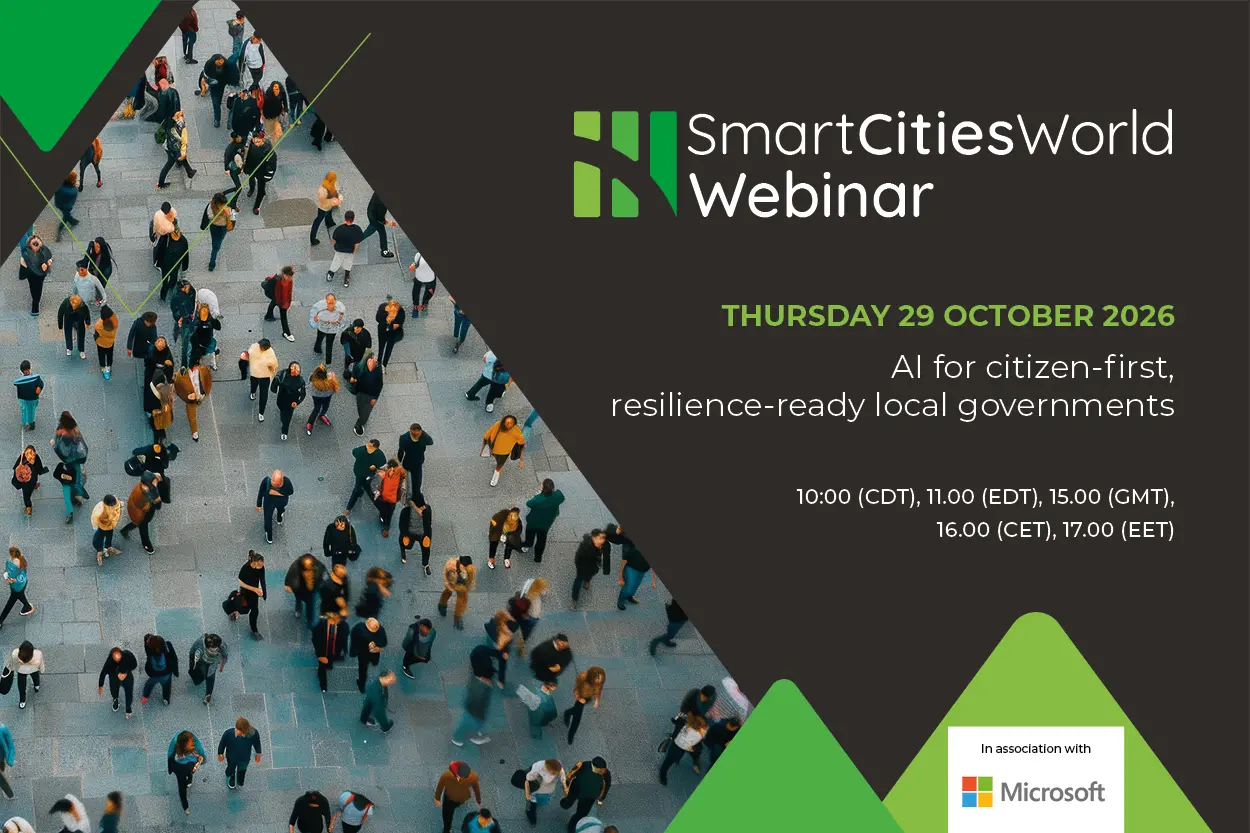
Webinar on 29 October to focus on AI for citizen-first, resilience-ready local government
A webinar on 29 October will examine how connected data and artificial intelligence can help local governments become more citizen-first and resilience-ready. The session is designed for local government leaders, urban technologists, public-sector partners and others working to improve public services. Its central theme is how cities can use AI not as a distant experiment but as a practical tool for citizen engagement, breaking down departmental silos and enabling faster, better-informed decisions.
The discussion will explore how AI, edge computing and computer vision can help cities turn growing volumes of urban data into smarter, faster decisions and more responsive services. Organizers frame the event around a familiar but urgent problem: many cities now collect large amounts of data from sensors, cameras, service requests, transport systems and administrative records, yet that data often remains fragmented across departments or is not used quickly enough to shape decisions.
The webinar is also set against the combined pressures of climate change, infrastructure resilience and digital transformation. As cities confront these overlapping challenges, the conversation is expected to focus on how urban leaders can translate strategy into practical action rather than treating AI as a standalone technology project.
Key facts
- The webinar takes place on 29 October and focuses on AI for citizen-first, resilience-ready local governments.
- Core themes include connected data, artificial intelligence, citizen engagement, departmental silos, faster decision-making and more responsive services.
- The session will examine AI, edge computing and computer vision as tools for turning growing volumes of urban data into better decisions.
- The context includes climate change, infrastructure resilience and digital transformation, with an emphasis on moving from strategy to practical action.
- Related examples include AI-powered urban innovation in Malaysia, Singapore's smart-nation efforts and Sunderland's use of digital infrastructure and low-carbon innovation.
- Further discussion points include Professor Jung Hoon Lee's work on AI moving from pilots to real-world impact, the emerging AI super gap between cities, and the role of data platforms, AI-ready infrastructure and effective governance.
- Smart sensor networks are highlighted as a way to improve indoor safety by detecting risks early, improving situational awareness and supporting healthier, more secure and sustainable buildings.
- Urban AI applications are expected to evolve further, with examples already showing significant impact in city settings.
Why connected data matters for citizen-first services
Citizen-first local government depends on more than a friendly digital front door. It requires public services to be joined up behind the scenes. When a resident reports a pothole, a broken streetlight or a missed waste collection, the response should draw on data from multiple systems: asset registers, work-order platforms, sensor feeds, geographic information systems and service-performance dashboards. If those systems do not talk to each other, the citizen experiences delay and repetition while staff spend time reconciling records.
Connected data can help local governments move from reactive service delivery to more anticipatory management. For example, combining weather data with drainage and road maintenance records can help teams prioritize inspections before heavy rainfall. Linking building permits, energy data and transport patterns can support planning decisions that reduce congestion or improve resilience. The point is not simply to collect more data but to create the conditions in which data can be trusted, shared and acted on.
AI can help with pattern recognition, triage and forecasting, but it depends on strong data foundations. Local governments need clear ownership of data, common standards, quality controls and governance arrangements that protect privacy and build public trust. The webinar's emphasis on citizen engagement suggests that technology should be assessed by whether it improves outcomes for residents, not by whether it is novel.
Breaking silos and improving decisions
Departmental silos are one of the most persistent barriers to better public services. Budgets, performance targets and legacy systems often reinforce separation, even when a resident's problem crosses several service areas. AI can expose those connections by bringing together information in new ways, but it can also reinforce silos if it is deployed as a series of isolated pilots. The more durable approach is to build shared data platforms and governance mechanisms that allow departments to collaborate around common outcomes.
Faster, better-informed decisions do not necessarily mean automated decisions. In many cases, the immediate benefit is improved situational awareness: managers can see where demand is rising, where service levels are slipping or where resources should be redirected. AI-assisted analytics can help prioritize work, detect anomalies and summarize large volumes of information for decision-makers. Human oversight remains essential, particularly in areas involving vulnerable residents, enforcement or the allocation of limited public resources.
Edge computing and computer vision in urban settings
Edge computing and computer vision are likely to feature prominently in the discussion because they change what is possible in real time. Edge computing processes data close to where it is generated, which can reduce latency and bandwidth use while keeping more data local. Computer vision can help cities interpret images and video for tasks such as detecting infrastructure defects, monitoring crowding, identifying environmental hazards or supporting public safety. These capabilities can make services more responsive, but they also raise important questions about surveillance, consent, accuracy and accountability.
For local governments, the most credible use cases are often narrow and well-defined. A camera system that detects blocked drains or damaged pavement may be easier to justify than broad monitoring of public space. A sensor network that flags unsafe indoor air quality or early fire risk can support healthier and more secure buildings. The common thread is early detection: identifying risks before they become costly failures or emergencies.
Resilience, climate and infrastructure pressures
Cities are increasingly being asked to prepare for shocks and stresses that cut across traditional departmental boundaries. Heatwaves, flooding, ageing infrastructure and rapid population change can expose weaknesses in systems that were designed for different conditions. Resilience-ready local government means having the data, coordination and decision-making capacity to anticipate disruption and respond quickly.
AI can support resilience by improving forecasting, scenario planning and asset management. It can help cities model the likely impact of severe weather, prioritize maintenance, identify vulnerable locations and coordinate responses across agencies. But resilience is not only a technical question. It also depends on governance, procurement, workforce skills and public trust. A city that deploys advanced analytics without clear accountability or community engagement is unlikely to achieve lasting benefits.
The event's wider context points to a broader shift in urban innovation. Cities are moving from isolated smart-city pilots toward integrated programs that connect data, infrastructure and services. The challenge is to ensure that these programs are designed around citizen needs and long-term resilience rather than short-term technology demonstrations.
From pilots to real-world impact
Professor Jung Hoon Lee's related work highlights how AI is moving from pilots to real-world impact in cities worldwide. The discussion references a global smart-city ranking, the emerging AI super gap between cities, and why the next phase of urban innovation depends on data platforms, AI-ready infrastructure and effective governance. That framing is important because it shifts attention from novelty to capability. Cities that can integrate data, build reusable infrastructure and govern AI effectively are likely to move faster than those that rely on fragmented experiments.
The concept of an AI super gap also suggests that the benefits of urban AI may not be evenly distributed. Cities with stronger digital foundations, skilled workforces and stable governance may be better placed to scale successful projects. Smaller or less well-resourced local governments may need shared services, regional partnerships and practical procurement models to avoid falling further behind.
Related examples show the range of activity underway. Malaysia is positioning itself as a leader in AI-powered urban innovation through a Southeast Asian smart city expo in Kuala Lumpur. Singapore continues to build its reputation as one of the world's smartest nations. Sunderland is repositioning itself as a leading smart city by using digital infrastructure and low-carbon innovation to build a resilient, future-focused economy. These examples differ in scale and approach, but they share a focus on linking technology to economic, environmental and social goals.
Indoor safety, sensor networks and healthier buildings
Smart sensor networks are another practical area of attention. Sensors can help improve indoor safety by detecting risks early, improving situational awareness and supporting healthier, more secure and sustainable buildings. In schools, hospitals, offices and public facilities, early detection of air-quality problems, water leaks, fire risks or unusual environmental conditions can prevent disruption and reduce long-term costs.
The value of these systems depends on how well they are integrated with building management, emergency planning and public reporting. A sensor that raises an alert but does not trigger a clear response is of limited use. Local governments therefore need to think about operating models, staff training and data governance alongside hardware deployment.
What to watch at the webinar
The 29 October webinar is expected to offer a practical view of how local governments can move from ambition to implementation. Key questions include how to build a shared data foundation across departments, how to assess AI use cases by public value rather than novelty, and how to protect privacy while using data to improve services. Another question is how cities can procure and govern AI in ways that remain accountable to residents.
The discussion will also need to address skills and capacity. Local governments often rely on external partners for analytics, cloud infrastructure and AI tools, but they still need enough internal expertise to set requirements, manage contracts and evaluate outcomes. Without that capability, cities risk becoming dependent on vendors or adopting systems that do not fit local needs.
The webinar's focus on citizen-first, resilience-ready local government reflects a maturing conversation about urban technology. The test is no longer whether a city can run a pilot, but whether it can turn data and AI into reliable public services that work for residents during ordinary days and extraordinary shocks. As cities face climate change, infrastructure pressures and digital transformation at the same time, that test is becoming more urgent.
Source: Smart Cities World News