

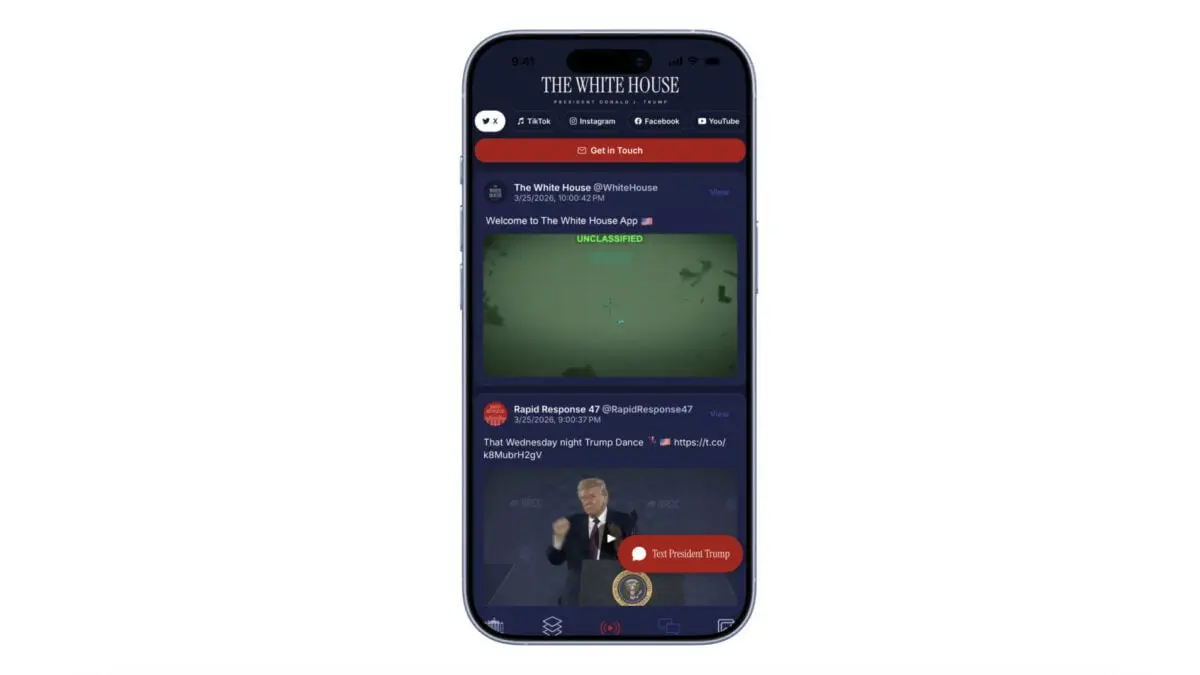
If you work for the Department of Homeland Security, an app is about to be auto-loaded onto your work phone, sort of like that U2 album that auto-loaded on everyone’s iPhone in 2014, except instead of delivering “Songs of Innocence,” the app claims to deliver “unfiltered, real-time updates straight from the source”—the source being Donald Trump. The White House app, initially released in March for voluntary download, is now being pushed onto DHS-issued devices via a mandate from the Trump administration. An internal email obtained by Politico notified DHS employees that the app would be automatically installed, describing it as “a convenient way to access official White House communications, including announcements, executive actions, speeches, livestreams, videos and other updates.”
The app’s features, as listed in the official White House press release, include breaking news alerts on major announcements, executive actions, and key priorities; video streaming of White House events; a library of archived Trump speeches and sound bites; the ability to “stay connected” with new policies; and an option to send feedback to the White House, including by voice. However, the press release’s illustration for the app—a screenshot showing a post that says “That Wednesday night Trump dance🕺🇺🇸”—has drawn ridicule, though the White House apparently provided that image themselves. The app also has a data-sharing component that has raised eyebrows: according to Notus.org, the app collects and shares users’ time zone, IP address, and other data with third parties, and it “doesn’t disclose its data sharing the way most others do,” meaning it may not comply with standard privacy transparency norms.
This forced installation is not unique to DHS. Last month, the Trump administration instructed all federal agencies to install the app on government-issued phones, and the Federal Aviation Administration (FAA) was one of the first to receive it as an auto-download. The move has sparked alarm among cybersecurity experts and former government IT officials. Sonny Hashmi, a former IT executive for the General Services Administration (GSA), told Government Executive that auto-installs of the app are “cause for alarm,” warning that “any app that is installed on government issued devices can potentially create backdoor access to government networks behind the firewall.” Hashmi’s concern reflects a long-standing principle in cybersecurity: every additional piece of software on a device expands the attack surface, and apps that communicate with external servers—especially those tied to a political figure—introduce risks of data exfiltration, malware injection, or even unauthorized surveillance.
The White House app is not the first of its kind. In 2010, the Obama White House released a similar app that provided news, photos, and video from the administration. That app, too, was available on iOS and Android, but it was never forced onto government devices. The Obama-era app was launched during the early smartphone app boom, when “there’s an app for that” was a cultural mantra. It offered features like live streaming of press briefings and a virtual tour of the White House. However, it did not have the same level of integration with federal IT networks, nor did it receive the same push for mandatory installation. The Trump administration’s approach represents a significant escalation in using official mobile applications as a direct channel to federal employees, bypassing traditional internal communication systems.
Data privacy is another flashpoint. The app’s privacy policy, or lack thereof, has drawn criticism from watchdog groups. Standard practice for most mobile apps includes a clear disclosure of what data is collected, how it is used, and whether it is shared with third parties. The White House app reportedly does not follow these norms. By collecting time zone and IP address, the app can infer users’ locations and browsing habits. Sharing this data with unspecified third parties could lead to targeted advertising, political profiling, or even more nefarious uses if the data falls into the wrong hands. For government employees, who handle sensitive information, such data leakage could pose national security risks. The Electronic Frontier Foundation and other civil liberties organizations have called for a halt to the mandatory installation until a full privacy audit is conducted.
The broader context includes Trump’s history of using social media and direct communication to bypass traditional media and government channels. During his first term, Trump frequently used Twitter to announce policy changes, fire officials, and share his thoughts. The White House app seems to be an extension of that strategy, now tailored for federal employees. The app also allows users to provide feedback directly to the White House, including by voice—a feature that some analysts worry could be used to collect audio data without explicit consent. The administration has not clarified how voice feedback is stored or processed.
From a technical standpoint, auto-installing an app on government devices is not impossible, but it requires coordination with mobile device management (MDM) systems used by agencies. While IT departments can push apps remotely, doing so without employee consent can breed distrust. Many federal employees are already wary of surveillance on work devices, and mandatory apps that collect personal data may exacerbate those fears. Moreover, the app’s integration with White House servers could create a new vector for cyberattacks. If the app’s backend is compromised, attackers could potentially push malicious updates to thousands of government phones, gaining access to internal networks. This risk is amplified by the fact that the app was developed by a third-party vendor, Notus.org, which has not undergone public security review.
Comparisons to the U2 album incident are apt but understate the seriousness. In 2014, Apple automatically downloaded U2’s “Songs of Innocence” onto all iTunes accounts, causing a public relations backlash. The move was seen as an invasion of digital space, but it posed no security threat. In contrast, the White House app auto-install raises genuine security and privacy issues. A U2 album cannot access your location or share data with third parties; the White House app can. Furthermore, the precedent set by forcing a political app onto government devices could be exploited by future administrations. If a president can mandate that all federal employees have an app that delivers their updates, what stops a future leader from using it to push propaganda or monitor dissent?
The Trump administration has defended the app as a tool for efficiency and transparency. A White House spokesperson argued that the app ensures federal workers are “informed directly by the Commander-in-Chief without filter or distortion.” But critics counter that there are already numerous secure channels for internal communications, and that the app duplicates functions while introducing unnecessary risks. The DHS email reportedly framed the app as optional, but the auto-install makes it effectively mandatory. Employees who attempt to uninstall it may face pushback from IT, as the app could be locked as a “corporate required” app. This tension between operational needs and employee autonomy is a recurring theme in modern workplace technology.
Looking ahead, the app’s rollout may face legal challenges. Privacy and security groups are considering litigation, arguing that the mandatory installation violates employees’ rights under the Privacy Act of 1974 and the Fourth Amendment’s protections against unreasonable searches. The government’s reliance on a third-party service with opaque data practices could also run afoul of federal procurement rules. Moreover, the app’s presence on devices that also store sensitive files—such as encryption keys, classified briefings, or personal identifiable information—creates a regulatory minefield. The FAA’s early participation suggests that even safety-critical agencies are not exempt from the mandate, raising questions about potential interference with operational technology.
In summary, the White House app auto-install on DHS devices is a major development at the intersection of politics, technology, and cybersecurity. It echoes past controversies but introduces new risks due to its data collection and network access. As the administration pushes forward, the tech community, civil liberties advocates, and Congress will be watching closely. The outcome could set a precedent for how future administrations deploy official apps on government hardware.
Source: Gizmodo News