

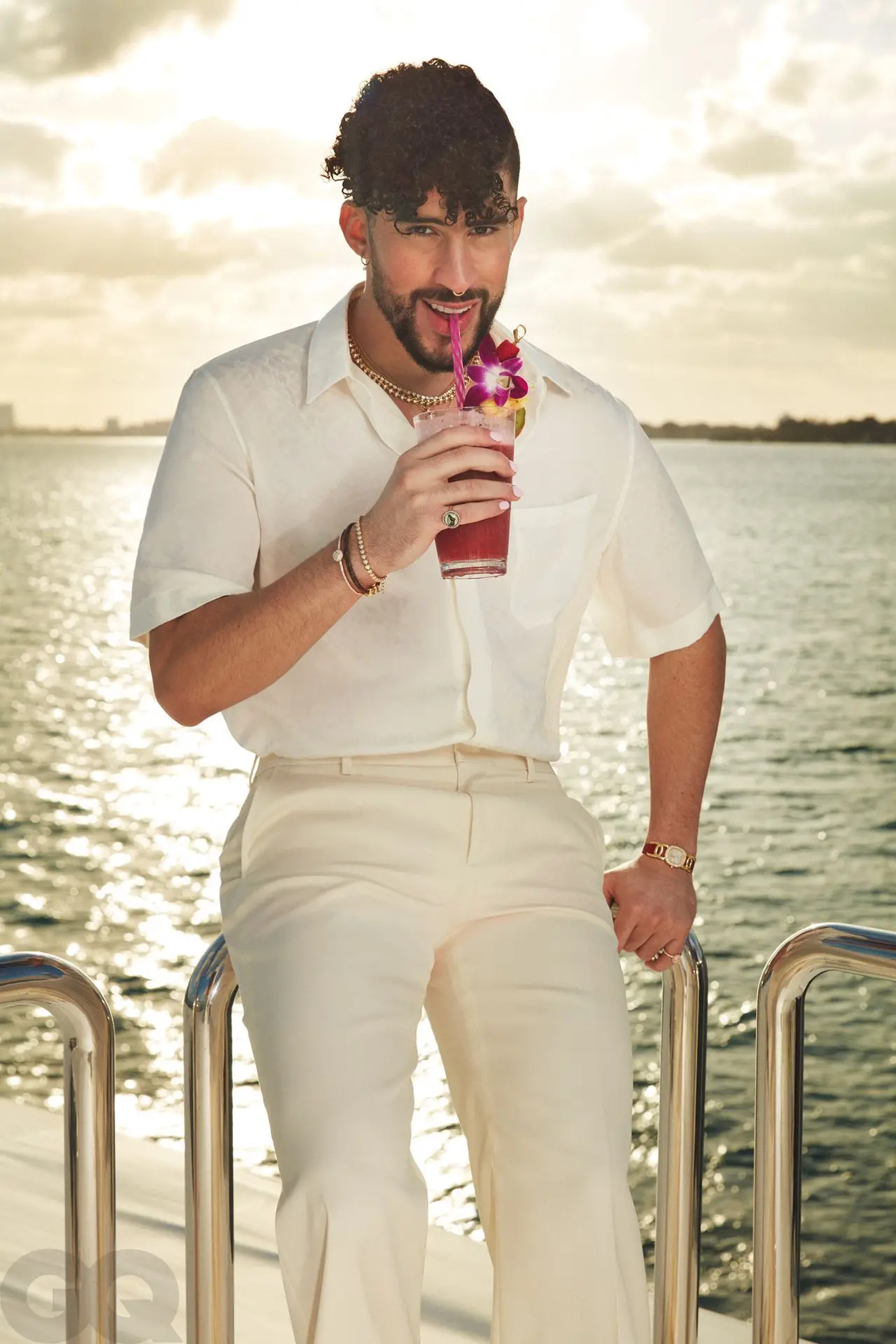
Headline: Bad Bunny: The Latinx Superstar Rewriting Pop, Reggaeton and Masculinity
Key facts
- Who: Bad Bunny, born Benito Antonio Martínez Ocasio, is a Puerto Rican singer, rapper and actor.
- Why now: After a long-delayed 25-date tour, he released Un Verano Sin Ti on May 6, 2022.
- Global reach: He was the most-streamed artist on Spotify in 2020 and 2021, and his all-Spanish album El Último Tour del Mundo topped the main U.S. album sales chart.
- New frontier: He was cast as El Muerto, the first Latino Marvel character to lead a film, after roles in Narcos: Mexico and Bullet Train.
- Cultural impact: He uses gender-fluid fashion and songs such as "Yo Perreo Sola" to challenge reggaeton machismo and anti-Latinx bias.
In a sunlit house in North Miami, Bad Bunny is trying to finish an album in the least album-like setting imaginable. The sliding glass doors are open, the pool glitters outside, a chef is working in the kitchen, and friends, producers, stylists and assistants drift through the patio. A small beagle named Sansa, three months old, scampers around with a plush rabbit. The scene feels closer to a long summer weekend than to the pressure cooker of global pop. Yet the man at the center of it is not just another musician on vacation. He is, by several measures, the most listened-to artist in the world.
Bad Bunny, whose real name is Benito Antonio Martínez Ocasio, has spent the past six years changing the shape of pop and reggaeton. The 28-year-old Puerto Rican singer has done so by refusing many of the rules that were supposed to govern a Latin trap and reggaeton star. He wears what he wants, sings almost entirely in Spanish, speaks openly about Puerto Rican politics, and treats masculinity as something far more flexible than the genre's traditional imagery. The result is a career that has broken streaming records, filled stadiums, crossed language barriers and made him a cultural figure far beyond music.
At the time of this encounter, he had just finished a long-delayed 25-date tour that followed his third solo album. He was still coming down from the adrenaline. He was sleeping badly, going to bed around one or two in the morning and waking around ten, but often lying awake. "I don't know if it's the same for everyone, or if it's just me, but the bigger the success, the higher I go, the more the pressure builds," he said. The pressure has not stopped. By late April, he had also landed the role of El Muerto, a superpowered wrestler and enemy of Spider-Man, in what was announced as the first Marvel film led by a Latino character.
From Vega Baja to global stage
Benito grew up in Vega Baja, a mid-sized town in northern Puerto Rico. His father drove trucks; his mother was a teacher. He describes himself as a shy boy, tender with his parents, fond of drawing and clowning around, and not especially sporty. Much of his childhood was spent in his room or outside, inventing worlds. He would climb a small rock and imagine it was a kingdom struck by lightning. A neighbor kept telling his parents that he talked to himself and should see a doctor. His father replied that he was simply playing.
Music came through the family. His parents played salsa, ballads, merengue and mainstream radio hits. He sang in a church choir and later tried rap at a school talent contest. Reggaeton was trickier. He was allowed to listen to Vico C only after the artist softened his street edge, and Tego Calderón became his first real obsession. When he did not want to get out of bed for school, his parents threatened to take away Tego Calderón. He got up fast.
After high school, he enrolled at the University of Puerto Rico in Arecibo to study visual communication. He began making beats and writing songs, keeping them to himself at first because he wanted the flow, rhythm and lyrics to be serious. Around 2014, he dropped out and took a job bagging groceries at a supermarket. A friend, Ormani Pérez, who later became his DJ, urged him to post tracks on SoundCloud. The response was almost immediate: a few listeners became hundreds of thousands, then a million. He kept refreshing the page to see the numbers rise.
In 2016, he was approached by Noah Assad of the small label Rimas Entertainment. At the time, the strategy was unusual. Instead of waiting to release an album, the plan was to put out a stream of singles and strategic features. It worked. Bad Bunny was already generating hundreds of millions of views; soon his audience was counted in the billions. His 2016 breakout "Soy Peor" was followed by collaborations with Drake on "Mia" and with Cardi B and J Balvin on "I Like It." He released a joint album with J Balvin, a compilation and three solo albums. El Último Tour del Mundo became the first album sung entirely in Spanish to reach the top of the main U.S. album sales chart.
By 2020 and 2021, he was the most-streamed artist on Spotify. His most recent tour grossed nearly $117 million. Tickets for his next stadium run, the World's Hottest Tour, sold out in minutes. "It was completely crazy," he recalled. The success has made him a global pop star, but it has also made him more aware of the pressure that comes with each new level. "Sometimes it really keeps me from sleeping when I think about it," he said. "I don't sleep for several days."
Breaking the language barrier
For years, Latin artists who wanted to break into the U.S. market were expected to record in English. Enrique Iglesias, Shakira and Ricky Martin all followed that path. Bad Bunny has helped prove that the rule no longer holds. "That barrier has fallen," he said. "Everyone is playing in the same league now, on the same field. I've been saying that from the start."
His approach was never to write for an English-speaking audience. "I never woke up one morning and said I was going to conquer the world," he explained. "It happened naturally. I never said, I'm going to write a song to please the gringos. Never. I always wrote songs as if only Puerto Ricans were going to hear them. And that's still the case: I forget that the whole world is listening."
That refusal to translate himself has become central to his appeal. His songs mix reggaeton, trap, Latin pop, psychedelic textures, electronic sounds and traditional Latin American rhythms. He has collaborated with artists from across the Spanish-speaking world and beyond, but he has kept Spanish at the center. The result is a body of work that has made the global pop market more multilingual and more open to Latin artists who do not reshape themselves for the United States.
Fashion, gender and reggaeton machismo
Bad Bunny's visual language is as important as his music. In North Miami, he wore a royal blue short, neon-green sandals, a black T-shirt with the word "bebé" spelled in rhinestones across the chest, a beige bucket hat, pale-pink nail polish, a gold nose ring, earrings and a necklace of small diamond hearts. His style is playful, fluid and deliberately unresolved. He rejects the idea that clothes have a fixed gender. "What defines a man? Who decides what is masculine or feminine?" he asked. "To me, clothes have no gender. A dress is a dress. If I wear a dress, does that mean it's not a woman's dress? And vice versa? Not at all. It's neither a woman's dress nor a man's dress. It's just a dress, period."
That attitude has made him a target for some and a hero for many. Latin American culture, he notes, remains deeply machista. Reggaeton in particular has long demanded that its stars look and act hyper-masculine. "People think a reggaeton artist has to dress and behave a certain way," he said. "But why? Why should the music I make define my clothing style?" He does not see himself as a spokesman or a teacher. He says he does not wear a mask or play a character. "I am who I am and I'm comfortable with that, I'm proud of it."
His song "Yo Perreo Sola" became an anthem against sexual harassment and violence against women. In February 2020, he appeared on a late-night television performance wearing a skirt and a T-shirt honoring a recently murdered trans woman, using the moment to draw attention to transphobia. He is aware that such gestures can provoke backlash, but he treats them as part of a broader refusal to accept reggaeton's old rules. "I don't intend to lecture people," he said. "When someone hears my song and thinks, 'Damn, that's true,' maybe it changes their state of mind a little. I don't fool myself: it won't completely transform them, but it adds something. Maybe they start to realize certain things and adjust their behavior."
Politics, Puerto Rico and Latin American pride
His politics are rooted in Puerto Rican identity. He speaks often about the idea that America does not mean only the United States. That conviction has shaped both his music and his public actions. In January 2019, he and Puerto Rican rapper Residente visited Governor Ricardo Rosselló to discuss crime on the island, then joined protests that eventually forced the governor to resign. Residente's song "This Is Not America," inspired by Childish Gambino's "This Is America," became an important text for Bad Bunny. He recalled listening to it while drinking with friends and being moved to tears. "I got chills," he said. "I don't know if it was because I was a little drunk or what. But that song is brilliant."
His album Un Verano Sin Ti is less explicitly political, but Latin pride runs through it. Much of it was recorded in a villa in the Dominican Republic. He prefers to avoid studios whenever possible. "As soon as I get in the car to go to the studio, my desire to go evaporates," he said. "At home, everything flows. Here, we get up, eat something and get to work." He rented a house, brought his team, installed the equipment and recorded on site. The album, released on May 6, 2022, became a 23-track summer playlist with seven guests, including Puerto Rican star Rauw Alejandro. Reggaeton dominates, but the record also reaches into traditional, psychedelic and electronic sounds.
He is acutely aware of how Latin artists have been undervalued. He recalled a magazine list of the greatest singers of all time that included no Juan Gabriel, no Vicente Fernández and no Tito Rodríguez. "Don't talk about these artists as the greatest if you don't mention our legends too," he said. "Why call them legends if we can't compare them to Latin legends? Because they come from North America? Because they sing in English?" For Bad Bunny, the argument is personal. His fame has made him more attentive to his culture, his language, his family and his friends. "A lot of artists suddenly change their circle when they become famous," he said. "They become friends with someone because he also has money. I'm not interested in that. I keep the same people around me."
Acting, wrestling and the Marvel role
His move into acting has been another unexpected chapter. After a recurring role in Narcos: Mexico, he appeared in Bullet Train alongside Brad Pitt. "It was fire working with Brad Pitt," he said. "Every time they yelled 'Cut!' I was like, 'Oh shit, I'm with Brad Pitt!'" Then came the Marvel role. He was cast as El Muerto, a wrestler with superpowers and an enemy of Spider-Man. "I grew up watching wrestling on TV and I'm a Marvel fan," he said. "So this role was perfect for me. Honestly, it's so incredible to be part of this film that I still don't believe it."
Wrestling is not a side note. Between January and April 2021, with the pandemic forcing him to pause touring, he made appearances at WWE events and even won the 24/7 Championship, a title defended around the clock. Weeks after receiving a Grammy, he competed in a tag-team match with Puerto Rican wrestler Damian Priest at WrestleMania 37. He trained twice a day, building muscle and working on fighting techniques. His creative director, Janthony Olivares, said the intensity was destabilizing at first. "I knew it was a dream for him," Olivares said. "But he had always done music, and then he stopped everything that occupied him before to devote himself to this."
Fame, pressure and private life
Despite the scale of his fame, those close to him say he has not changed. His manager, Noah Assad, describes him as a great introvert, humble and shy, someone who likes to show love. Bad Bunny admits that success and money change some things, but insists that his inner self remains intact. He still spends time with his family. He took his first younger brother on tour as soon as he could, and when the youngest finished school, he brought him along too. He likes keeping a family cocoon around him.
He also protects his relationship with Gabriela Berlingeri, a singer and jewelry designer, and their dog Sansa. During the last tour, Gabriela surprised him at a Los Angeles arena. He was about to go back onstage after a short break when he learned they had arrived. He ran to the dressing room. "She's the one who made me run," he said, pointing at Sansa. "Not Gabriela." He laughed. "No, I'm joking, I'm lying, it was for both of them. I kissed Gabriela and I kissed Sansa." He does not want to turn his private life into a story, but he sometimes posts a photo of her. "Sometimes you can complain about social media, but it's really hard to resist," he said. "Everyone posts photos all the time. You tell yourself, 'I'm going to stay out of all that,' and a minute later you post a photo."
He knows that his rise has been dizzying. "There was a moment when I was completely stunned," he said. "Two years passed in the blink of an eye. It was a really strange period. It was as if before I was a jungle animal and suddenly I was put in a zoo. I kept doing the same thing, I worked every day, but clearly I was no longer in the jungle." He still feels the pressure of each new audience, each new summit. "Maybe for others it's the opposite," he said. "The higher they go, the less pressure they feel, because they're super confident. For me, it's the opposite. The wider my audience, the closer I get to the top, the more pressure I feel."
A summer album and a shared rhythm
As the day fades, the pool turns gold. Beto Rosado, his engineer and producer, sets up speakers for an impromptu listening session. Bad Bunny asks if I want to hear a few tracks from the new album. Jomar Dávila, his photographer, and Jesus Pino, his assistant, share a beer in the kitchen while the chef cleans the counter. Gabriela stays on the sofa, playing with Sansa. Benito sits on a stool and plays the opening track, an upbeat tropical reggae song about drinking beer on vacation. He stands in front of the speakers, nods to the rhythm, a glass of red wine in his hand, then moves toward the sofa. The volume is high. The puppy gets excited, wagging its tail and jumping to catch the plush rabbit that Bad Bunny waves above it.
He explains that it is the first time he has recorded so many songs for an album, that the final tracklist is not settled, and that the titles he plays may not all make the commercial release. The next song is with Bomba Estéreo, the Colombian group that describes its music as electro tropical. It is music for parties, for summer, the beach and the sun. He turns it up and starts dancing. Everyone follows. Heads sway, the group sings along, and Gabriela says the song makes her want a beer. Then comes a mambo-flavored track on which she sang a feature, though it did not ultimately make the album. She dances, and the others line up behind her in a conga line.
The party continues in the house. Benito, ecstatic, his bucket hat still on his head, asks what the dance is called. Esta es mi playa, the song says. Este es mi sol, esta es mi tierra. Esta soy yo. "This is my beach. This is my sun, this is my land. This is me." He asks whether it is bachata or merengue. No one knows exactly what to call it, but everyone knows how to dance it, as if by second nature. It is a shared history, a common past. He crosses the room with a few loose steps, then stops suddenly because he has found the answer to his question. "It's American!" Everyone around him laughs and dances harder.
Source: GQ France News