

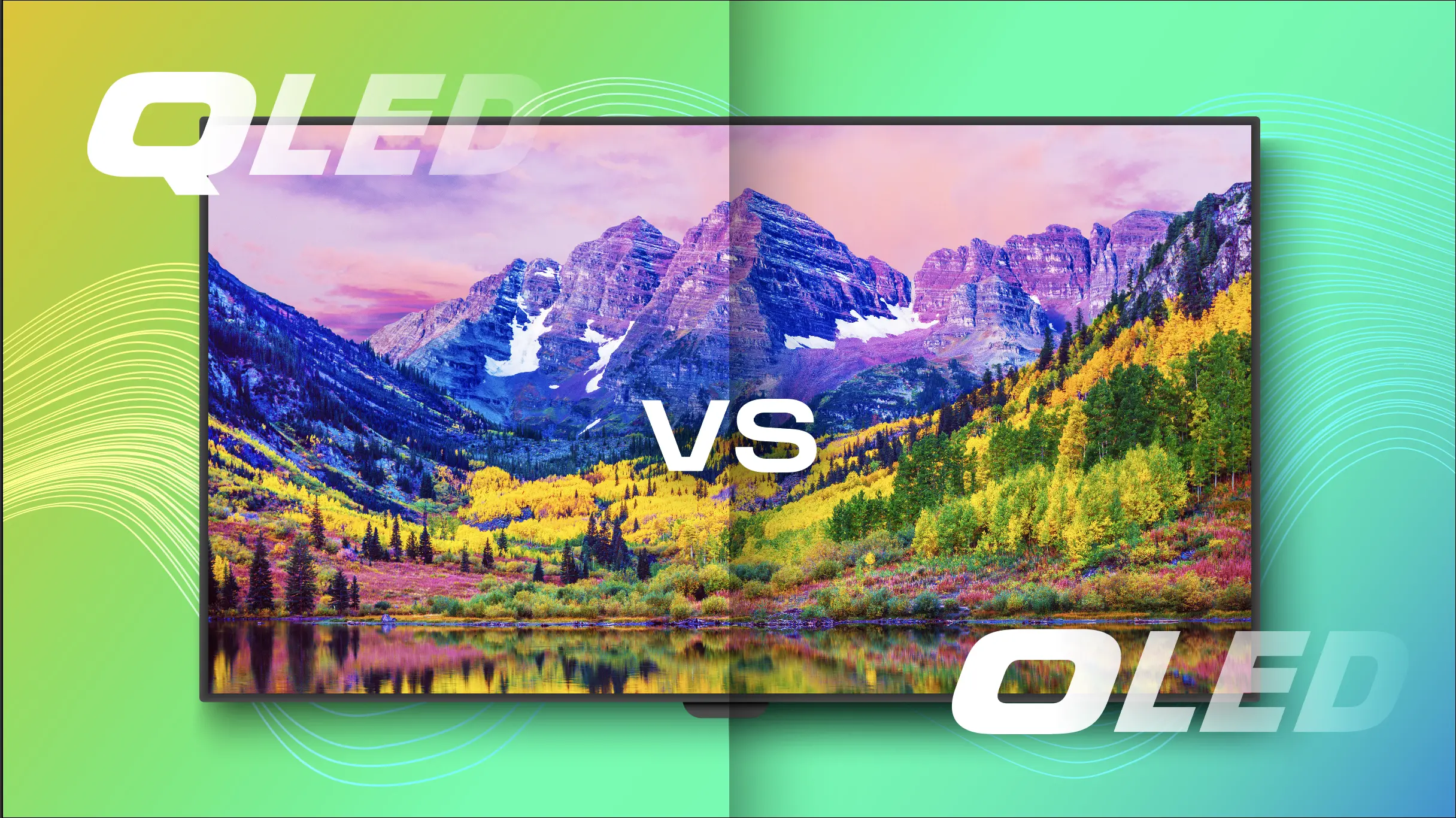
If you are shopping for a new TV, the jargon can pile up quickly. Terms such as HDR, 120Hz, HDMI 2.2, OLED, and QLED are often mixed together in marketing. OLED and QLED describe fundamentally different display technologies. They are not simply two brand names for the same type of panel. Understanding how each works can help you choose the right television for your room, budget, and viewing habits.
Key facts: QLED vs OLED
- OLED stands for organic light-emitting diode. It is an emissive technology, meaning each pixel produces its own light.
- QLED is a marketing term popularized by Samsung for quantum dot LED TVs. It is a variation of LCD, not a separate emissive display type.
- QLED TVs add a quantum dot film to an LCD sandwich and rely on an LED backlight. The light is transmitted through layers, so QLED is transmissive.
- OLED TVs do not need a backlight. Millions of individual OLED subpixels emit light, which allows very deep blacks and extremely thin designs.
- Both QLED and OLED are smart TVs with built-in apps. Both can deliver vivid color and bright images, but performance varies by model and price.
- OLED generally wins on contrast, black level, uniformity, and viewing angles. QLED generally wins on peak brightness and large-screen affordability.
- OLED sizes are more limited, while QLED and LCD TVs cover a wider range from small to very large screens.
- OLED burn-in is possible but usually avoidable with varied viewing habits. QLED and LCD TVs are less susceptible.
A QLED TV is an LCD TV with quantum dots
Quantum dots are microscopic molecules that emit colored light when struck by light. In a QLED TV, these dots are contained in a film. A blue LED backlight provides the energy. The light then passes through several layers, including a liquid crystal layer, to create the picture. Because the LED light travels through the layers to the screen, QLED is called a transmissive display. The quantum dot film helps improve color and brightness compared with older LCD designs.
Samsung began using quantum dots in its LCD TVs in 2015 and introduced QLED branding in 2017. The company says its quantum dots have improved over time. TCL also produces QLED TVs and has used Super Quantum Dots. Other brands, including Vizio and Hisense, use quantum dots in some LCD TVs but do not always use the QLED label. The key takeaway is that QLED is closer to standard LCD than to OLED. It is an enhanced LCD, not a fundamentally new emissive display class.
An OLED TV is not an LCD TV at all
LCD has dominated flat-panel TVs for years. It is cheaper than OLED, especially in larger sizes, and many panel makers can produce it. OLED is different because it does not use an LED backlight. Instead, light is produced by millions of individual OLED subpixels. The pixels themselves emit light, which is why OLED is called emissive. That difference creates major picture-quality effects. Some favor LCD and QLED, but most favor OLED.
OLED TVs can be extremely thin because they do not need a backlight assembly. All OLED TVs worldwide use panels manufactured by either LG or Samsung. Until 2022, LG was the only company making OLED panels. That year, Samsung began making its own panels using QD-OLED technology. QD-OLED combines quantum dots with OLED, promising improved color and brightness. In comparisons, QD-OLED sets have shown superb color. Newer OLED panel technologies, such as 4-stack designs, aim to improve brightness further. OLED technology is expected to keep evolving.
QLED and OLED vs LED
Are these all just LED TVs? Not technically. LED TVs are LCD TVs that use LED lights as a backlight. All QLEDs are LEDs, but not all LEDs are QLEDs. QLED adds quantum dots to the LCD structure. OLEDs are not LED TVs in the usual marketing sense. They use a different technology. Shoppers may also see Mini-LED TVs and MicroLED TVs. Mini-LED is mainly an advanced backlight for LCD screens. MicroLED is a separate emissive technology that uses tiny LEDs as pixels.
QLED vs OLED image quality
QLED picture quality varies more than OLED
QLED models span a wide range. The most expensive QLED series perform much better than cheaper ones. The biggest improvements often come from mini-LED backlights, better full-array local dimming, bright highlights, and better viewing angles. These features help high-end QLED sets outperform budget QLED and non-QLED LCD TVs. OLED picture quality is more consistent. Across reviews, OLED TVs tend to earn similar marks for picture quality because the core technology delivers stable black levels and contrast.
OLED has better contrast and black level
Black level is one of the most important image-quality factors. Because OLED pixels can turn off completely, OLED TVs produce true blacks and effectively infinite contrast. LCD-based QLED TVs rely on a backlight, so some light can leak through. Newer LCD technologies, such as advanced local dimming and Halo Control, have helped QLED and LCD models approach OLED black levels. Even so, OLED still has the edge in contrast.
QLED is brighter
The brightest QLED and LCD TVs can get brighter than any OLED model. That is a real advantage in bright rooms and with HDR content. OLED TVs, however, can still get bright enough for most rooms. Their superior contrast allows them to deliver a better overall HDR image in many comparisons. Brightness is not the only measure of HDR performance; contrast and black level matter just as much.
OLED has better uniformity and viewing angles
LCD-based displays can show uneven brightness across the screen. Backlight structure may also be visible in some content. Even the best LCDs can fade, lose contrast, or shift color when viewed from off-center seats. OLED TVs have nearly uniform screens and maintain image fidelity from almost any angle. This makes OLED a strong choice for rooms with wide seating arrangements.
Resolution, color, and processing are similar
Most QLED and OLED TVs have 4K resolution, and both can achieve 8K. Neither technology has a major inherent
Source: CNET News