

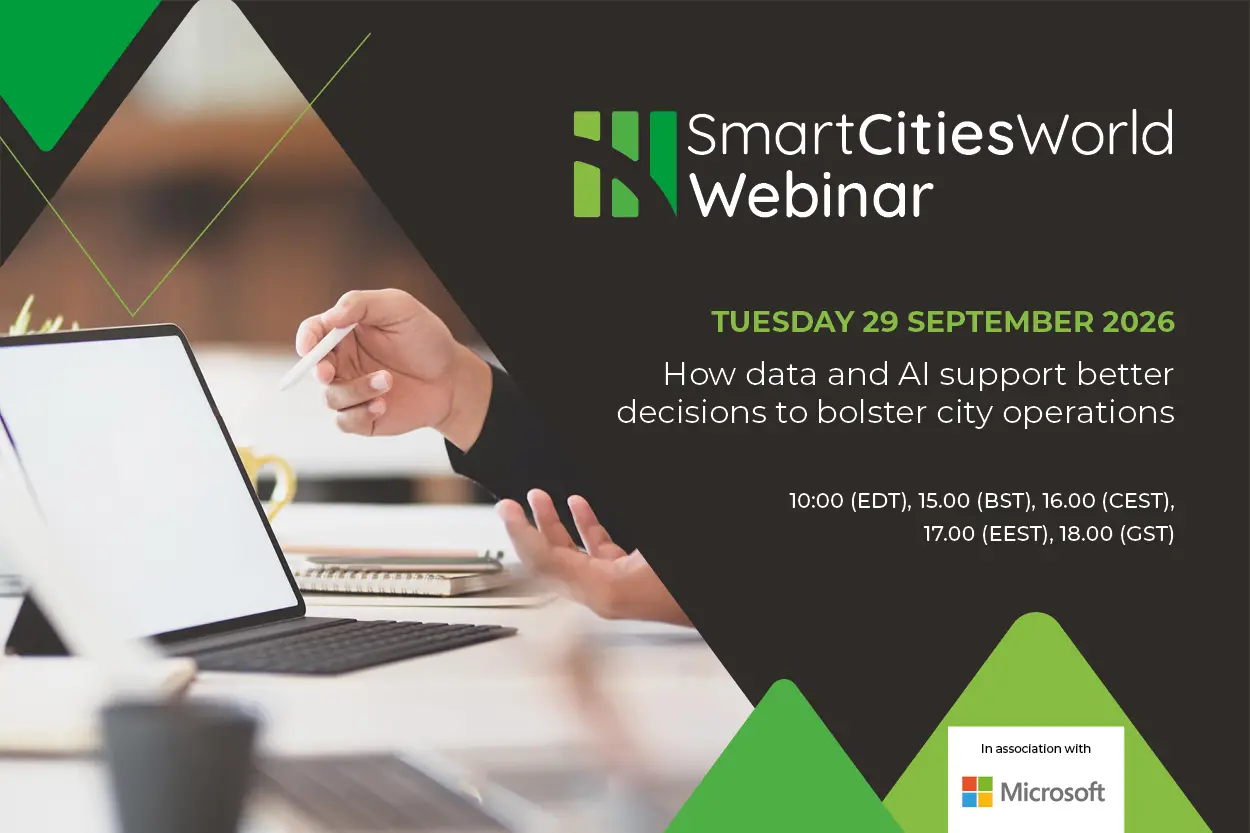
The on-demand webinar examines how connected data and artificial intelligence can support better decisions and strengthen city operations. It brings together the practical case for using data not as a static reporting asset but as an operational resource that helps city teams respond faster, coordinate more effectively and deliver services that reflect real conditions on the ground.
The session focuses on three connected outcomes: improving citizen engagement, breaking down departmental silos and enabling faster, better-informed decisions. Those outcomes matter because city governments are increasingly expected to manage complex systems in real time while balancing budgets, public trust and long-term resilience. The webinar argues that data and AI can help meet those expectations when they are embedded in workflows rather than treated as standalone technology projects.
Why data and AI matter for city operations
Cities generate growing volumes of information from sensors, service requests, transport systems, buildings, utilities and public-facing digital channels. Much of that data remains fragmented across departments or is used only after decisions have been made. The webinar explores how connected data and AI can close that gap by giving operational teams a more complete view of what is happening and what is likely to happen next.
For city leaders, the value is not simply more data. It is the ability to turn data into timely insight. AI can help identify patterns, prioritize resources and surface anomalies that might otherwise go unnoticed. Connected data can provide context across services, so an issue in one part of a city is not treated in isolation. The combined effect is a more responsive operating model in which decisions are informed by evidence from multiple systems.
The discussion also considers how AI can support citizen engagement. Cities can use data to understand demand, tailor communications and improve service access. When residents report problems or request services, AI-assisted systems can help route requests, detect recurring issues and give teams a clearer picture of where intervention is needed. The aim is not to remove human judgment but to give staff better information and more time for complex cases.
From data volume to operational insight
A central theme of the webinar is the shift from data volume to operational insight. Many cities already collect substantial data, but the challenge is to make it usable across departments and at the speed required for operational decisions. AI, edge computing and computer vision are presented as capabilities that can help cities turn growing volumes of urban data into smarter, faster decisions and more responsive services.
Edge computing matters because it allows data to be processed closer to where it is generated. In a city context, that can mean analyzing video or sensor data at the roadside, in a building or at a public facility rather than sending everything to a central system. Faster processing can support quicker alerts and reduce bandwidth demands. Computer vision can help interpret visual data from cameras and sensors, for example by detecting incidents, monitoring conditions or identifying maintenance needs. When combined with connected data platforms, these capabilities can feed operational teams with actionable information rather than raw feeds.
The webinar positions these technologies as part of a broader decision-support system. AI models need reliable data, clear governance and integration with existing processes. Edge computing needs secure infrastructure and maintainable devices. Computer vision needs privacy safeguards and public trust. The session therefore treats technology as one part of city operations, alongside people, policy and partnership.
Breaking down silos and improving citizen engagement
Departmental silos are a persistent barrier to better city operations. Transport, waste, housing, social services, emergency response and digital teams often hold separate datasets and use different systems. The webinar explores how connected data can create a shared view of city conditions and help teams coordinate around common priorities.
Breaking down silos does not mean removing departmental responsibility. It means making data and insight available across boundaries so that decisions reflect the wider impact on residents and services. For example, a road closure may affect waste collection, public transport, emergency access and local businesses. Connected data can help teams anticipate those effects and coordinate responses. AI can help prioritize actions by combining signals from multiple sources and highlighting where resources are most needed.
Citizen engagement is closely linked to this effort. Residents expect services to be responsive, transparent and easy to use. Data and AI can help cities understand demand patterns, improve communication and measure service performance. The webinar considers how better engagement can be built on better data, with city teams using insight to close feedback loops and show residents how their input informs action.
Edge computing and computer vision in the field
The webinar examines how AI, edge computing and computer vision can support city operations in practical settings. Edge computing can reduce latency and enable real-time responses. Computer vision can convert visual data into usable signals. AI can combine those signals with other data to support decisions. Together, these capabilities can help cities monitor infrastructure, detect risks and respond to incidents more quickly.
Examples discussed in the broader program include smart sensor networks that improve indoor safety by detecting risks early, improving situational awareness and supporting healthier, more secure and sustainable buildings. Such systems show how data and AI can move beyond dashboards and into everyday operations. The webinar also considers how urban AI applications are evolving, with projects already making significant impact in areas such as safety, maintenance, energy management and service delivery.
The discussion notes that adoption depends on more than technical performance. Cities need clear use cases, strong procurement, data standards and governance. They also need to plan for integration with legacy systems and ensure that frontline staff have the skills and confidence to use new tools. The webinar emphasizes that successful projects are usually those that solve a specific operational problem and demonstrate value before scaling.
Resilience, climate and digital transformation converge
Cities confront the combined pressures of climate change, infrastructure resilience and digital transformation. The webinar is set against this context and explores how those agendas intersect. Climate adaptation requires better data on risk, infrastructure performance and vulnerable communities. Resilience planning requires coordination across departments and partners. Digital transformation provides the tools to connect data and act on insight, but it also raises questions about governance, equity and long-term sustainability.
The broader event program brings urban leaders and partners together during London Climate Action Week to explore how these agendas intersect and how cities can translate strategy into practical action. The webinar contributes to that conversation by focusing on the operational layer: how data and AI can support decisions that improve services and strengthen resilience. It also highlights how different cities and markets are advancing AI-powered urban innovation, from Southeast Asian and Asia-Pacific examples to European cities repositioning themselves through digital infrastructure and low-carbon innovation.
City leaders are also paying attention to the emerging AI super gap between cities. The term describes the risk that some cities will pull ahead in AI capability while others struggle with data platforms, AI-ready infrastructure and effective governance. The webinar and related discussions emphasize that closing this gap requires investment in foundations, not just pilots. Data platforms, skills, governance and infrastructure are presented as prerequisites for scaling AI from experiments to real-world impact.
Practical pathways for city leaders
For city leaders, the webinar offers a practical pathway. Start with a clear operational problem, such as reducing response times, improving maintenance or coordinating services across departments. Identify the data needed to support decisions and assess whether that data is accessible, reliable and governed. Choose technology that fits the operating environment, including edge computing where speed and bandwidth matter and computer vision where visual data can improve situational awareness.
Build governance early. Privacy, security, procurement and accountability need to be part of the design. Engage frontline staff and residents so that new tools reflect real needs and maintain public trust. Measure outcomes, not just outputs. A successful AI project should show a measurable improvement in a service, a decision process or a resident outcome. Use those results to decide whether to scale, adapt or stop.
The webinar also stresses the importance of partnership. Cities rarely have all the capabilities in-house, and collaboration with technology providers, utilities, transport authorities and community organizations can accelerate progress. The on-demand format allows city leaders and partners to revisit the discussion, compare approaches and assess where connected data and AI can support more responsive operations.
Key facts at a glance
- The on-demand webinar explores how connected data and AI can improve citizen engagement, break down departmental silos and enable faster, better-informed decisions.
- It examines how AI, edge computing and computer vision can help cities turn growing volumes of urban data into smarter, faster decisions and more responsive services.
- The discussion is set against the combined pressures of climate change, infrastructure resilience and digital transformation.
- The broader event program brings urban leaders and partners together during London Climate Action Week to explore how these agendas intersect and how cities can translate strategy into practical action.
- The program highlights AI-powered urban innovation in Malaysia, including a first-of-its-kind Southeast Asian smart city exposition in Kuala Lumpur.
- It profiles Singapore as a city-state building its reputation as one of the smartest nations in the world.
- It profiles Sunderland as a city repositioning itself through digital infrastructure and low-carbon innovation to build a resilient, future-focused economy.
- Related discussions explore the Global Smart City Index, the emerging AI super gap between cities, and why the next phase of urban innovation depends on data platforms, AI-ready infrastructure and effective governance.
- Smart sensor networks can improve indoor safety by detecting risks early, improving situational awareness and supporting healthier, more secure and sustainable buildings.
- Urban AI applications are evolving, with projects already making significant impact and panel discussions covering cognitive cities and resilient infrastructure planning.
The session is available on demand, giving city leaders and partners the chance to review examples, compare approaches and assess where connected data and AI can support more responsive operations.
Source: Smart Cities World News