

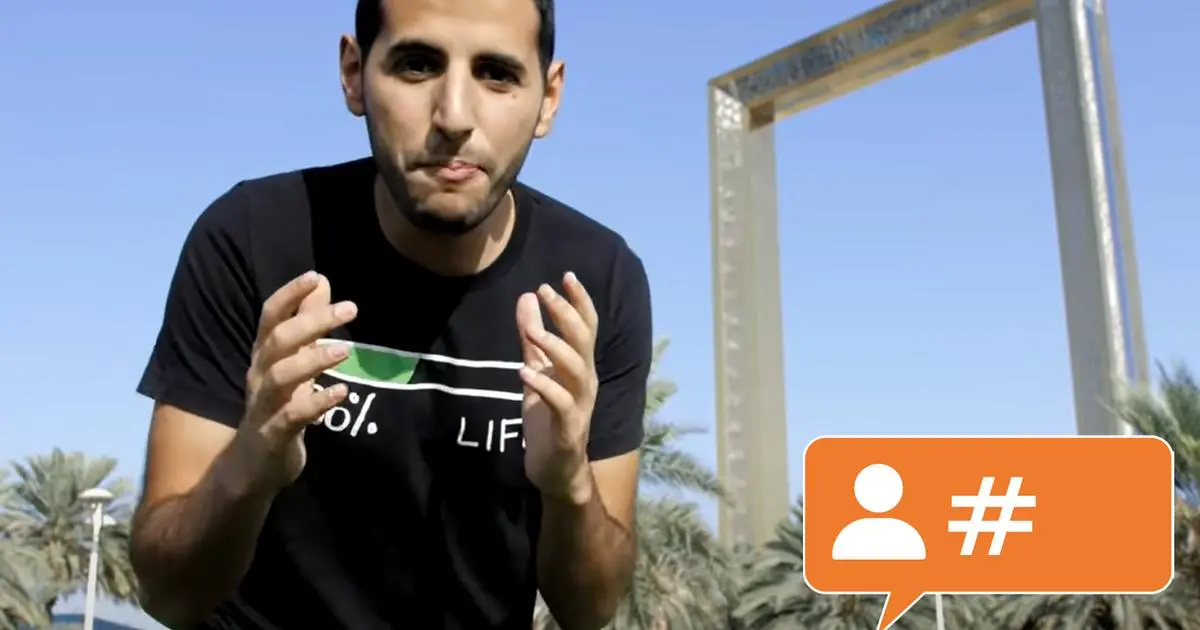
Nuseir Yassin, better known to millions as Nas Daily, appears at first glance to be just another social media influencer. With over 40 million followers across Facebook, YouTube, and TikTok, he produces short, fast-paced videos that celebrate extraordinary individuals and offbeat locations. But Yassin is not just a viral content creator; his journey from a small Arab town in northern Israel to global stardom is a remarkable story of determination, identity, and the search for common ground in a deeply divided world.
Early Life in Arraba
Born in 1992 in Arraba, a predominantly Arab city in the Galilee region of Israel, Yassin grew up in a complex cultural environment. His parents were Muslims who identified both as Israelis and Palestinians, a dual identity that reflects the intricate reality of Arab citizens of Israel. During his childhood, Yassin had no Jewish friends. This was not unusual, he later observed, in a country where Arabs and Jews often live in separate social bubbles, attend different schools, and rarely interact on a personal level.
The segregation of Israeli society left a deep impression on Yassin. Even as a young boy, he was acutely aware of the invisible walls that divided communities. This awareness would later shape his mission to bring people together through his videos. His hometown, Arraba, sits in the Lower Galilee, a region known for its olive groves and ancient history, but also for its limited economic opportunities. Like many young Arabs in Israel, Yassin faced systemic barriers that could have limited his future.
A Path to Harvard
Yassin discovered a passion for technology at an early age. Computers and the nascent internet offered him a window into a world far beyond his hometown. He realized, however, that his Arab origins might hinder a career in Israel's booming tech industry, which was largely dominated by Jewish professionals. Rather than accept this limitation, Yassin set his sights on an extraordinary goal: a degree from an elite American university.
Through exceptional academic performance and sheer determination, he earned a scholarship to Harvard University. At the age of 18, Yassin left Israel for the United States, a move that would change his life forever. At Harvard, he studied computer science and immersed himself in the culture of innovation that defines Silicon Valley and the broader American tech ecosystem. The experience exposed him to a diversity of ideas and people unlike anything he had known growing up.
His time at Harvard also allowed him to develop a network of contacts and friends from around the world. For the first time, he found himself in an environment where his identity was not a liability but an asset. His unique perspective as an Israeli-Palestinian became a topic of curiosity and conversation among his peers, giving him a platform to share his experiences.
From Tech to Storytelling
After graduating from Harvard, Yassin moved to New York City, where he landed a job as a software engineer at a payment processing company. For nearly two years, he lived the conventional life of a young professional in the city that never sleeps. He earned a good salary, enjoyed the comforts of urban life, and worked on technical projects that paid the bills but did not satisfy his soul.
Yassin felt a growing restlessness. He wanted to do something more meaningful, something that would connect him to people and places beyond the corporate bubble. In 2016, he made a bold decision: he would quit his job and travel the world, documenting his journey on social media. He set two ambitious goals: to visit 64 countries in 1,000 days and to publish a video every single day during that period.
The name "Nas Daily" comes from the Arabic word "nas" (people) and the English word "daily," reflecting his commitment to sharing stories about people, not places, on a daily basis. His first videos were crude and poorly edited, but they had a raw authenticity that resonated with viewers. He focused on capturing moments of everyday life, whether it was a street vendor in Bangkok, a teacher in rural Africa, or a scientist in a cutting-edge laboratory.
The Rise of a Digital Empire
Yassin's formula proved remarkably successful. His videos are typically no longer than one minute, perfectly optimized for the short attention spans of social media users. They feature rapid cuts, upbeat music, and a personal narration that makes viewers feel as if they are on the journey with him. Over time, he developed a distinctive style that set him apart from the crowded landscape of travel vloggers.
Within a few years, Nas Daily had exploded in popularity. Facebook, in particular, became his primary platform, with millions of followers eagerly waiting for each daily installment. His videos have tackled a wide range of subjects, from homelessness in Japan to the resilience of communities in war-torn countries. He has interviewed Nobel laureates, business tycoons, and local heroes, always trying to find the universal human story behind each encounter.
Yassin's ambition grew alongside his follower count. He expanded his team, bringing in videographers, editors, and researchers from around the world. The Nas Daily brand became a small media empire, with offices in Singapore, Dubai, and even a stint in the United States. He launched side projects, including a philanthropic arm that supports education and community development initiatives, and he began hosting live events and workshops.
A Bridge Between Two Worlds
Beyond the business success, Yassin's dual heritage has always been a central part of his public persona. As an Israeli citizen and a Palestinian Arab, he occupies a unique position in one of the most intractable conflicts in modern history. He has spoken openly about how his identity has been a source of confusion, discrimination, and sometimes privilege. In Israel, he is often seen as an Arab; in the Palestinian territories, he is sometimes viewed as an Israeli; and in the rest of the world, he is simply an influencer with a complicated background.
Yassin does not shy away from this complexity. In several videos, he has shared his personal reflections on the Israeli-Palestinian conflict, advocating for empathy and mutual understanding. He has visited both Israeli and Palestinian communities, giving his viewers a rare glimpse into the daily lives of people on both sides of the divide. While he does not claim to have political solutions, he believes that storytelling can break down stereotypes and build bridges.
A recent profile in a major American newspaper highlighted how Yassin's story challenges simplistic narratives. It noted that, despite the barriers he faced as a child, he managed to transcend them through education and perseverance. His journey from a segregated town in the Galilee to the global stage is a testament to the power of individual agency, as well as a reminder of the structural obstacles that still constrain many Arab citizens of Israel.
The Future of Nas Daily
As of 2023, Yassin shows no signs of slowing down. He continues to produce daily content, though his focus has shifted somewhat from personal travel to broader stories of innovation, culture, and human achievement. He has also used his platform to address pressing issues such as climate change, mental health, and the impact of technology on society.
In a world increasingly polarized by politics and identity, Yassin offers an alternative model: someone who refuses to be boxed into a single label. He is simultaneously Israeli, Palestinian, Arab, American, and global citizen. His videos are full of optimism and curiosity, qualities that are all too rare in today's digital landscape. Whether he is interviewing a refugee in Berlin or a tech entrepreneur in Seoul, Yassin's message remains consistent: every person has a story worth telling.
Source: Courrier international News