

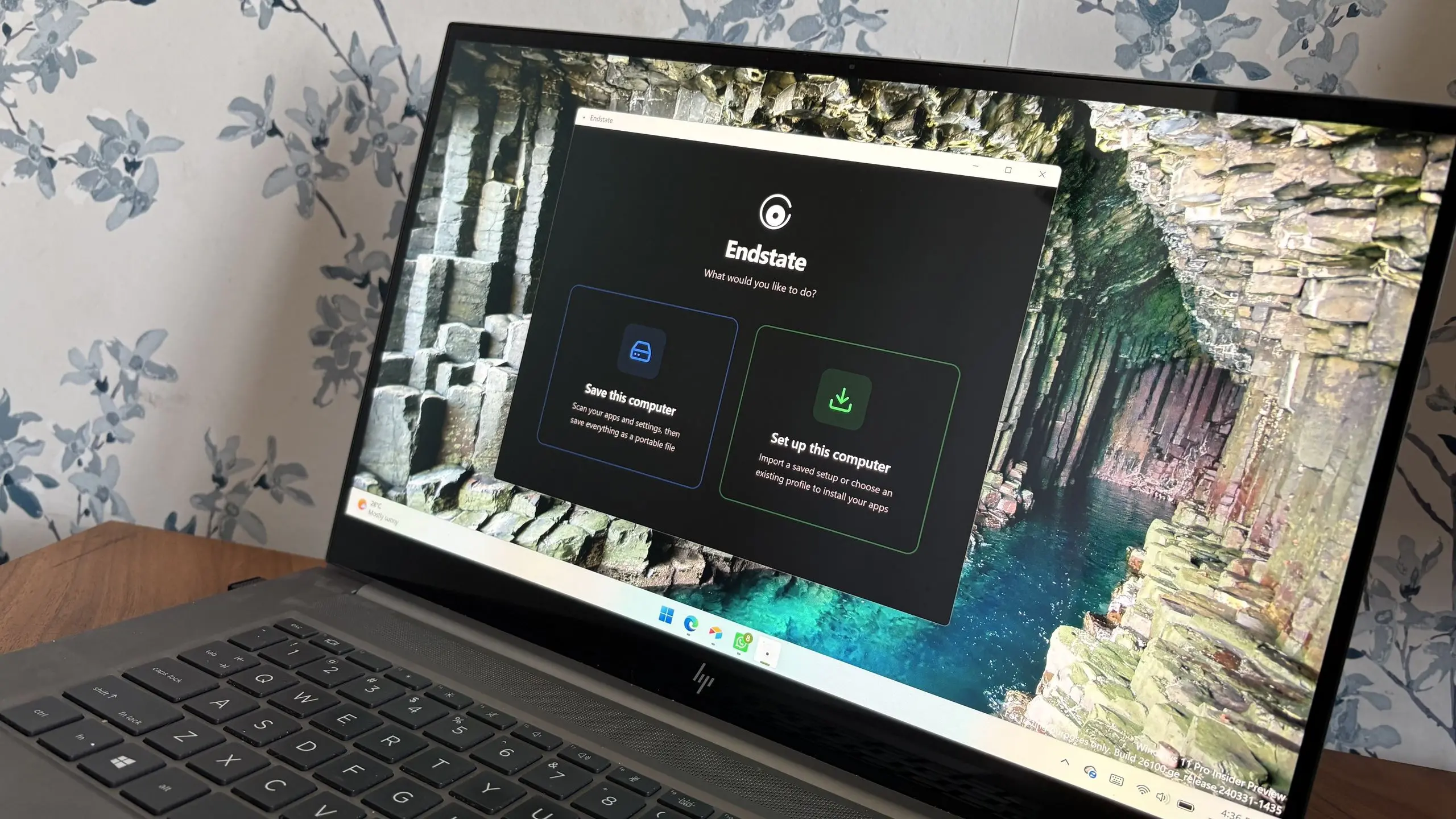
For anyone who has ever unboxed a brand-new Windows PC, the initial excitement often quickly gives way to a familiar frustration: the long, tedious process of setting everything up. From updating drivers and installing the latest Windows patches to downloading essential applications and configuring system settings, getting a fresh machine ready for real work can take hours. This pain point is exactly what a new app called Endstate aims to eliminate. I recently had the opportunity to speak with its solo developer, who shared the story behind the app, how it works, and why it could fundamentally change the way we approach Windows setup.
The Problem: Why Setting Up Windows PC Feels Like a Chore
Every Windows user knows the drill. After booting a new PC for the first time, you are greeted by a clean desktop, but behind the scenes, the system is missing countless components. Graphics card drivers need to be downloaded from manufacturer websites, chipset drivers must be updated for peak performance, and the Windows Update service often requires multiple restarts to catch up on months of patches. Then there are the third-party essentials: a web browser, antivirus software, productivity suites, media players, and communication tools. For IT professionals or enthusiasts who set up multiple machines, this process repeats endlessly. Even for casual users, the time investment is significant. According to a survey from a major tech research firm, the average user spends between three and six hours configuring a new PC before they feel comfortable using it for daily tasks. The developer of Endstate recognized this inefficiency and set out to create a one-tool solution.
How Endstate Streamlines the Setup Process
Endstate is not just another bloatware installer or a simple script. It is a polished application that guides users through a step-by-step automation of the entire setup workflow. Once installed on a fresh Windows PC, the app scans the hardware to detect all connected components, including the motherboard, GPU, network adapters, and peripherals. It then cross-references the detected hardware with a comprehensive database of official driver sources. The user can select which drivers to install, or simply click a single button to fetch them all. Beyond drivers, Endstate also integrates with popular package managers like Chocolatey and Winget to deploy a curated list of software applications. The interface is clean and modern, with clear progress indicators and minimal technical jargon. The developer explained that the inspiration came from his own experience as an IT consultant, where he would repeat the same setup tasks dozens of times a week. He felt there had to be a better way, and after months of coding and testing, Endstate was born.
A Conversation with the Creator: The Journey from Idea to Launch
During our interview, the developer detailed the early challenges. Building a reliable hardware detection system required extensive research into Windows hardware IDs and driver packaging standards. He also had to ensure that the app would not install outdated or mismatched drivers, a common problem with generic driver update tools. The solution was to source drivers directly from official OEM databases and verify their digital signatures before installation. The app also includes a rollback feature that creates a restore point, so if something goes wrong, the system can be reverted to its pre-setup state. The developer emphasized that Endstate is designed with safety as a priority. It will never install third-party toolbars, adware, or unnecessary trial software. All the applications it offers are from the official Microsoft Store or directly from the developers’ websites, and users have full control over what gets installed. The app is currently in early access but has received positive feedback from beta testers, many of whom have reduced their typical setup time from four hours to under thirty minutes.
Key Facts About Endstate
- One-click driver detection and installation for over 10,000 hardware components
- Integration with Winget and Chocolatey for software deployment
- Automatic Windows Update management to ensure all patches are applied
- System restore point creation before any changes
- Support for offline PC setups with a pre-downloaded driver repository
- Portable version available that runs from USB without installation
- No bloatware or advertisements, fully transparent and open-source option in consideration
- Compatibility with Windows 10 and 11 across all editions
How Endstate Differs from Other Tools
The market already has several driver update utilities, such as Driver Booster, Snappy Driver Installer, and Intel’s own Driver & Support Assistant. However, Endstate distinguishes itself by focusing on the entire setup experience rather than just drivers. While most tools require multiple separate installations—one for drivers, another for software, a third for system tweaks—Endstate consolidates them into a single session. Its workflow resembles a setup wizard that can be configured once and reused across many machines. For IT professionals, this means they can create a custom profile that includes specific drivers and software for their organization, then deploy Endstate to all new PCs with a simple configuration file. The developer mentioned that this feature was heavily requested during the beta phase and has become a core selling point. Moreover, Endstate does not nag users to upgrade to a paid version; the base features are completely free, with optional premium features like cloud profile syncing and advanced reporting for enterprise customers.
Hardware Compatibility and Performance Impact
One of the biggest concerns with driver automation tools is compatibility. Outdated or incorrect drivers can cause system instability, blue screens of death, or hardware not functioning properly. Endstate addresses this by using a combination of Microsoft’s own driver catalog (WHQL) and direct manufacturer APIs. For example, for NVIDIA GPUs, the app queries the official GeForce driver database and downloads the latest Game Ready or Studio driver, bypassing any third-party repositories. Similarly, for Realtek audio chips and Intel network adapters, the app fetches the exact drivers from the respective vendors. During testing, the developer reported zero instances of driver-related crashes when using the recommended settings. The app also performs a disk space check before downloading large files to avoid filling the system drive inadvertently. Performance overhead during setup is minimal, as the app multithreads downloads and installations, utilizing all available CPU cores to speed up the process.
User Experience and Feedback from Early Adopters
Initial users have praised Endstate for its simplicity and reliability. A common sentiment expressed on forums like Reddit and TechPowerUp is that the app feels like a tool Microsoft should have built itself. One user noted that after using Endstate, they set up a new laptop in under 20 minutes, including the installation of Microsoft Office, Discord, Steam, and all necessary drivers. Another user, a system administrator for a small business, reported using Endstate to prepare 50 new Dell workstations. He said that before Endstate, each machine took about 45 minutes of hands-on work. With Endstate, the same task now takes 10 minutes per machine, saving his team over 29 hours of labor. The developer also shared that the app has built-in telemetry (opt-in) to collect anonymized data about common hardware configurations, which helps him improve driver compatibility and add support for rare components. Many users have also requested a command-line mode for scripting, and the developer confirmed that a CLI version is in development.
Technical Details: How the App Detects Hardware
Under the hood, Endstate uses a combination of Windows Management Instrumentation (WMI), registry queries, and direct device instance IDs. It reads the PNPDeviceID and HardwareID from each device, then looks up a local database that maps these IDs to the correct driver packages. The local database is updated daily from a cloud source, ensuring that users always have access to the latest driver versions. For offline scenarios, the app allows users to pre-download the entire database onto a USB drive, making it possible to set up PCs without an internet connection—a crucial feature for remote deployments or secure environments. The developer also implemented a delta update mechanism; if a driver is already up to date, the app skips it, saving bandwidth and time. Security is handled through driver signing checks; any driver that fails signature verification is blocked from installation unless the user explicitly overrides the warning. During our conversation, the developer stressed that transparency is key: the app logs every action taken, and the log can be exported for review.
The Road Ahead: Future Features and Community Involvement
The developer has an ambitious roadmap for Endstate. Planned features include a web-based dashboard that allows remote management of multiple PCs, integration with enterprise deployment tools like SCCM and Intune, and support for Linux dual-boot setups. He is also considering open-sourcing the hardware detection module to foster community contributions. The app is written in Rust for performance and safety, with a React frontend for the UI. The choice of Rust helps prevent common memory safety issues that plague similar tools written in C++ or C. The developer is also working on a “driver rollback” timeline where users can revert not just to the last restore point, but to any previous driver version they had installed, a feature requested by overclockers and enthusiasts who occasionally encounter compatibility issues with newer drivers. Monetization will remain generous: the core features stay free forever, while advanced features like cloud sync, custom profiles for businesses, and priority support will be subscription-based. The developer emphasized that he wants Endstate to be accessible to everyone, as the problem of PC setup is universal.
Why This App Matters in a World of Cloud Computing
Even as many tasks move to the cloud, the local operating system remains the foundation of personal computing. A properly configured Windows PC is essential for gaming, creative work, development, and productivity. The time wasted on repetitive setup tasks is an opportunity cost that Endstate aims to recover. In an era where efficiency is prized, tools that automate mundane but critical workflows are increasingly valuable. The developer's approach—starting from a personal frustration and building a meticulous solution—mirrors the origins of many successful software projects. Endstate is not just a utility; it is a reflection of the modern desire to spend less time on system maintenance and more time on actual work or play. As the Windows ecosystem continues to evolve with new hardware and updates, Endstate’s adaptive approach ensures it will remain relevant.
The developer concluded our conversation by thanking the early user community and expressing optimism about the future. He invited anyone interested to try Endstate and provide feedback directly, noting that the app is still in its early stages and that user input is shaping its direction. For anyone who has ever groaned at the prospect of setting up a new PC, Endstate might just be the solution they have been waiting for.
Source: Windows Central News