

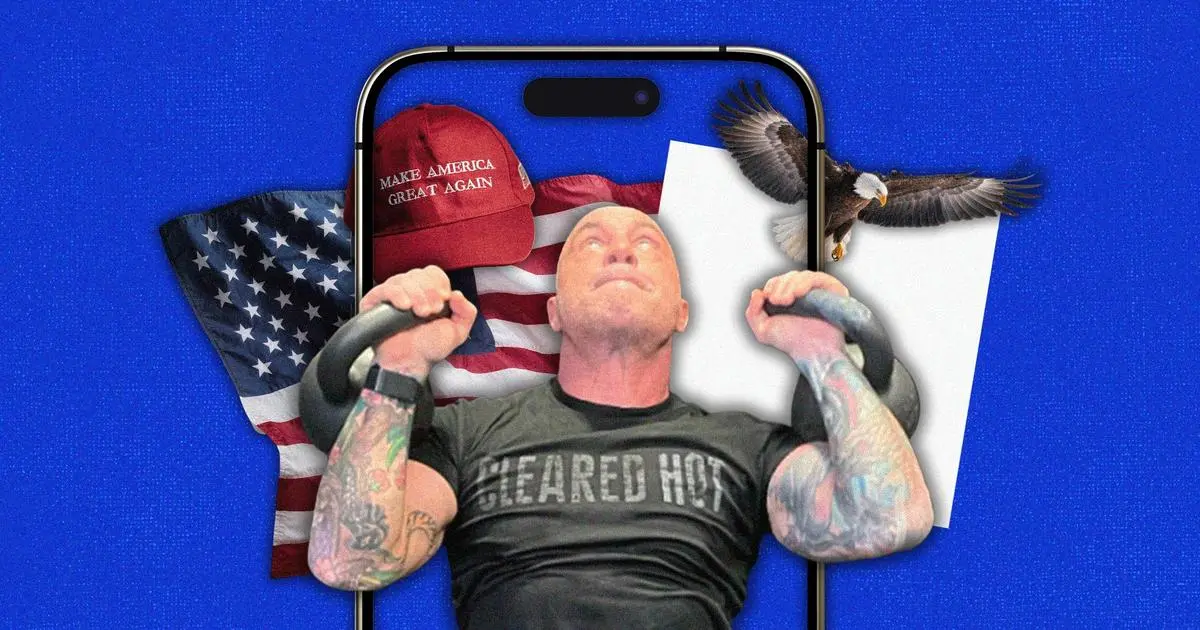
One does not easily say no to Joe Rogan, even when one is the President of the United States. In April, the most-listened podcaster in the world sent a message to Donald Trump to advocate for ibogaine, a psychedelic drug he has long praised for its therapeutic virtues, particularly for veterans suffering from post-traumatic stress disorder. Trump’s reply was immediate: “Great! You want FDA approval? Let’s go!” A week later, Rogan was in the Oval Office with Health Secretary Robert Kennedy Jr. and Trump himself for the signing of an executive order accelerating research on the substance. “We all respect Joe. He is a little more progressive, but that’s fine,” Trump said on the occasion.
The scene was a vivid illustration of how far Rogan has come from his early days as a stand-up comedian and mixed martial arts commentator. He is not a politician, nor does he claim to be a journalist. He is a talker, a listener, and above all a man with a microphone and an audience that most television networks can only dream of. For more than fifteen years, he has hosted a daily show that draws roughly 57 million views each month. His audience is loyal, enormous, and increasingly influential in American political life.
From comedy clubs to podcast royalty
Joe Rogan was born in Newark, New Jersey, and grew up in a middle-class environment. He began his career in comedy in the late 1980s, performing in Boston and New York before moving to Los Angeles. He appeared on television in the 1990s on shows such as “Hardball” and later became widely known as the host of “Fear Factor,” where contestants confronted their deepest fears for a cash prize. But his true love was martial arts. As a taekwondo black belt and former champion, he naturally found a place as a commentator for the Ultimate Fighting Championship, where his energetic, unfiltered style made him a fan favorite.
In 2009, he launched “The Joe Rogan Experience,” initially as a casual conversation with friends and fellow comedians. The format was simple: sit down, press record, and talk for hours. There was no script, no tight editing, and no attempt to fit within a conventional media structure. Over time, the podcast grew from a cult favorite to a global phenomenon. Rogan interviewed scientists, athletes, authors, conspiracy theorists, actors, and eventually politicians. His studio became a crossroads where highbrow intellectual discussion coexisted with crude humor, where legitimate medical experts shared time with fringe figures. This mix, often explosive, turned him into one of the most controversial and most compelling figures in modern media.
A political evolution
Rogan was not always politically engaged. For many years, he described himself as libertarian-leaning and largely uninterested in electoral politics. He joked about politicians, criticized both parties, and avoided endorsing candidates. When he did talk about politics, it was often through the lens of individual freedom, personal responsibility, and skepticism toward institutions. This instinctive worldview, he once said, led him to positions that “resemble those of an average American.” That line became a central part of his public identity: a man who speaks his mind, changes his mind, and refuses to fit into a partisan box.
This political fluidity made him a particularly unpredictable force in the Trump era. During the 2016 campaign, he expressed doubts about both Donald Trump and Hillary Clinton. He later said he voted for Libertarian candidate Gary Johnson. In 2020, he endorsed Bernie Sanders in the Democratic primaries, then supported Andrew Yang after Sanders’s exit. He repeatedly said he would vote for Joe Biden, though with little enthusiasm. His audience, largely young and male, was not monolithic. Rogan’s willingness to talk to guests from across the political spectrum made his show an essential stop for politicians, even those who disagreed with him.
In 2024, however, Rogan shifted. He hosted Donald Trump on “The Joe Rogan Experience” for a wide-ranging conversation that lasted several hours. The episode was a massive event, generating millions of views and extensive media coverage. Trump, who had once mocked podcasters and frequently demanded a more traditional interview format, leaned into the platform. Rogan subsequently supported Trump’s re-election, a decision that surprised many of his longtime listeners. The endorsement, if it could be called that, was not based on deep ideological alignment. Rogan seemed to view Trump as the lesser evil, or perhaps as the candidate most likely to shake up a system he found broken. Whatever the exact reasoning, the effect was real: Rogan gave Trump access to a vast audience of young men who might otherwise have stayed home on election day.
The ibogaine episode
Rogan’s influence has never been more visible than during the ibogaine story. For years, he had discussed the drug on his podcast, describing personal experiences and sharing anecdotes about its potential to heal trauma. Ibogaine, derived from a West African plant, has been used in some countries as an experimental treatment for addiction and PTSD. In the United States, its legal status is highly restricted, and it has not received federal approval as a medicine. Rogan argued, with characteristic confidence, that the government should research it seriously instead of treating it as a mere recreational drug.
When Trump won the presidency in 2024, Rogan saw an opportunity to push the issue directly. The text exchange over the FDA, followed by the Oval Office meeting, represented a direct line from a podcast conversation to presidential action. The executive order was modest in scope, but symbolically powerful. It signaled that the new administration was willing to listen to non-traditional voices, especially those with large influence. For Rogan, it was proof that his platform mattered beyond entertainment. For his critics, it was another example of how democratic decision-making could be shaped by a celebrity with access to power.
Distancing from Trump
Yet the relationship between Rogan and Trump has shown signs of strain. In recent months, Rogan has distanced himself from many of Trump’s policy positions and public statements. He has expressed frustration with certain appointments and decisions, though he has not fully revoked his support. The distance appears to reflect Rogan’s broader political temperament. He is not a party loyalist and has never been comfortable with total allegiance. When he agrees with a president, he says so. When he disagrees, he says that too. This makes him impossible to control, a reality that both the left and the right have had to accept.
In an era of hyper-partisan media, that refusal to stay on message has made Rogan a target. Progressives attacked him during the pandemic for inviting guests who questioned vaccine mandates. Conservatives attacked him for criticizing Trump. He has been called a “useful idiot” for the right, a “gateway to fascism” for the left, and everything in between. Through it all, his audience has remained remarkably stable. His ability to absorb criticism and continue producing long, unedited conversations is perhaps his greatest political asset. He does not need to win debates. He only needs to keep talking.
The power of the long conversation
The strength of Rogan’s show lies in its format. A two-hour conversation cannot be reduced to a soundbite. Guests are invited to explain themselves at length, and Rogan often plays devil’s advocate, pushing back with a mix of curiosity and populist skepticism. For public figures, the format can be a trap or an opportunity. Trump, in his 2024 appearance, was given time to speak uninterrupted in ways that cable news no longer allows. Other politicians, including Bernie Sanders and Tulsi Gabbard, have also used the show to reach voters who distrust traditional media.
This long-form approach has reshaped political communication. It allows guests to be nuanced, but it also gives dangerous ideas room to spread. Rogan has defended his decision to host controversial figures by saying that conversation, not censorship, is the best way to challenge bad ideas. His critics argue that he provides a platform for misinformation without adequate fact-checking. The debate over his role is unlikely to disappear, especially as his political influence grows.
Rogan’s audience is not the typical cable news demographic. It is overwhelmingly male, relatively young, and often skeptical of institutions. These are voters who are not easily reached by traditional campaigns. They are also voters who have, in recent years, moved toward Trump in significant numbers. Rogan’s endorsement may not have changed millions of minds, but it likely helped create permission structures for listeners who admired him. In a close election, that can make all the difference.
A new kind of kingmaker
The presidency has changed how Rogan is viewed. He is no longer just a podcaster with a loyal following. He is a kingmaker, or at least a gatekeeper of public conversation. When he speaks about a drug, presidents respond. When he interviews a candidate, campaigns shift. When he expresses disappointment, the White House notices. This influence is not institutional. It is based entirely on attention, and attention in the digital age is a form of power that traditional media envy.
Rogan has also become a symbol of the broader fragmentation of American media. The old gatekeepers who controlled what the public heard, television anchors, newspaper editors, film studios, have lost their monopoly. Podcasts have emerged as alternative spaces where anyone with a microphone and a topic can build an audience. Rogan was an early pioneer, but he is also a product of this transformation. His success inspired countless imitators, from conservative podcasters to wellness influencers to partisan commentators.
The series of which this profile is a part has examined the rise of these influencers under the first Trump administration. Figures like Tucker Carlson, Ben Shapiro, Candace Owens, and others have built powerful audiences by offering unapologetic commentary outside the constraints of traditional journalism. Rogan is different. He does not fit neatly into the conservative ecosystem. He is more unpredictable, more willing to question his own side, and less interested in ideological purity. Yet his effect on politics has been similar: he has helped move the center of gravity toward a more combative, more personal, and more media-driven form of political engagement.
For now, Joe Rogan remains the undisputed king of podcasters. His daily show continues to attract millions of listeners, and his bank of contacts reaches from the White House to the world of mixed martial arts. His journey from comedian to political influencer has not followed a planned path. It has been a series of instincts, controversies, and unexpected encounters. Whether he remains as influential in the years to come depends less on his political future and more on his ability to sustain the intimacy that made him powerful in the first place.
What is certain is that established political leaders, from Donald Trump on down, now understand that they cannot afford to ignore him. They may not always agree with him. They may even try to win with him, and then discover he is impossible to keep on a leash. But in the modern media landscape, where trust in institutions has collapsed and loyalty is measured in clicks and subscriptions, a man with a microphone and 57 million monthly views has become one of the most consequential figures in American public life.
Source: Le Figaro News