

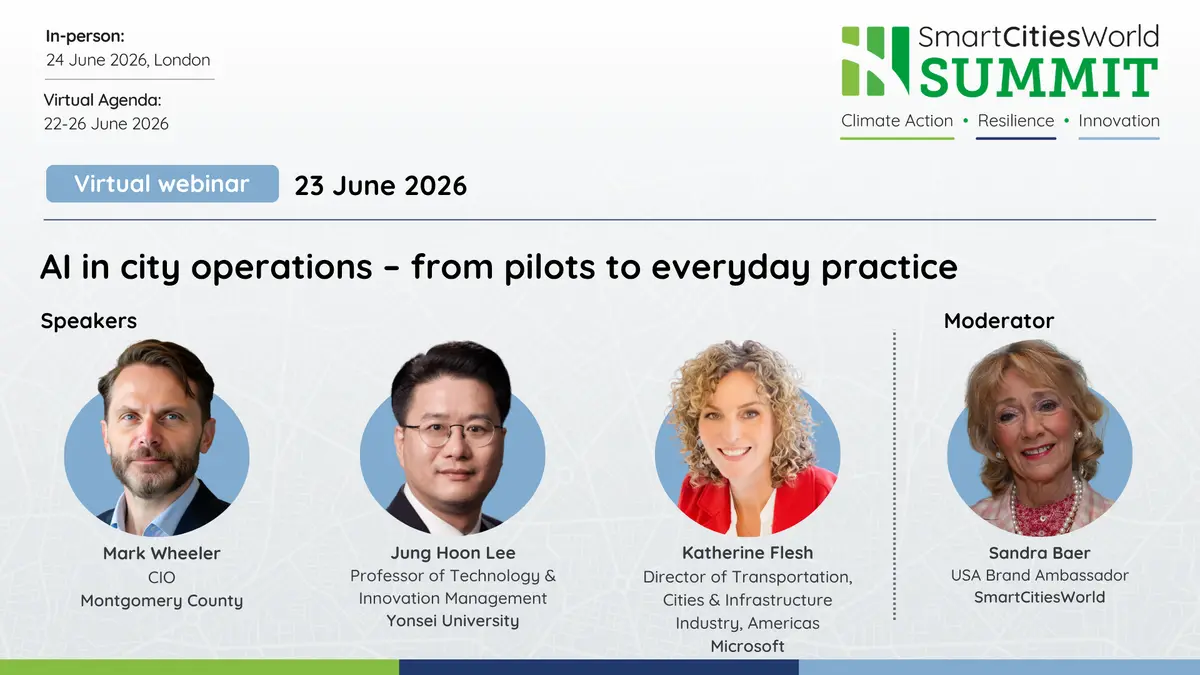
Local authorities are reaching a critical pivot in their use of artificial intelligence. For years, city departments have run small-scale pilots covering everything from traffic management to citizen support. Yet too many of those pilots end quietly, unable to show sustained benefits or survive a change in leadership. A new virtual panel discussion, titled AI in city operations – from pilots to everyday practice, will examine why this cycle persists and how cities can make AI a routine part of urban governance. The conversation will focus on three building blocks: unified data, agentic AI, and secure digital infrastructure.
Key themes
The panel will explore how local authorities can strengthen workforce decision-making by combining reliable data, AI systems that can act on that data, and digital foundations that protect critical operations. A growing body of evidence suggests that successful smart city initiatives depend less on any single algorithm and more on the organisational structures around it.
Key facts
- The panel will look at moving AI from small-scale trials to everyday operational practice.
- Unified data, agentic AI, and secure digital foundations are the core themes.
- Speakers will examine risk-based approaches to infrastructure resilience.
- Research on Sunderland’s smart city programme shows measurable economic, social, and public-service benefits.
- Singapore continues to build its reputation as one of the world’s smartest nations.
- Professor Jung Hoon Lee has warned of an emerging ‘AI super gap’ between leading and lagging cities.
- Cybersecurity must be designed into smart lighting infrastructure, according to Paradox Engineering’s Fabio Mauri.
- Microsoft’s Katherine Flesh says transport AI success depends on data foundations, workforce readiness, and responsible governance.
Why pilots fail
City pilots often fail because they are built around a technology rather than an operational problem. An AI model may perform well on historical data but cannot be maintained when the vendor contract ends or when the original data scientist leaves. A second barrier is fragmentation. In many local authorities, transport data sits in one department, energy data in another, and public safety data in a third. Without a single source of truth, AI can only offer partial answers.
Unified data as the starting point
Unified data does not mean that every city system must flow into one giant database. It means creating shared standards, open interfaces, and carefully governed access rights so that decisions can draw on the most complete picture available. The panel will discuss practical steps such as creating city data platforms, establishing strong metadata conventions, and using data contracts between departments and external suppliers.
Agentic AI in city services
Agentic AI refers to systems that do more than generate predictions or recommendations. They can take actions within defined boundaries, monitor the results, and trigger workflows. In a city environment, this might mean an AI that automatically adjusts traffic signals after detecting congestion, deploys maintenance crews in response to sensor alerts, or routes residents to the right public service. These tools can strengthen workforce decision-making by reducing repetitive tasks and giving human staff better recommendations.
Secure digital foundations
New powers bring new risks. A city that uses AI to control critical infrastructure has a greater obligation to secure that infrastructure. The panel will consider how cybersecurity needs to evolve from a compliance exercise to a core design discipline.
Cybersecurity in smart infrastructure
Fabio Mauri, a technology and cybersecurity leader at Paradox Engineering, argues that smart lighting offers an important lesson. Lighting is increasingly used as a backbone for connected cities, hosting sensors, cameras, and communication nodes. If those systems are not secured from the start, an attacker could potentially move from a streetlight to a wider network. Mauri’s work stresses that security must be embedded in the device, not added as an afterthought.
A risk-based approach to infrastructure resilience
The session will also discuss how cities can shift from reactive maintenance to a more strategic, risk-based approach. This means understanding which assets matter most to public safety and economic continuity, and using AI to target investment where it will have the greatest impact.
Digital infrastructure and community-led services
Digital infrastructure alone is not enough. Community-led services, agile transformation, and strong governance are equally important. The panel will hear from Juan Carlos Lopez, Chief Technology Officer and head of a value management office at Cayala, a large private city development in Central America. Lopez has described how agile transformation, digital infrastructure, and community-led services are supporting the expansion of one of the region’s largest private cities. His experience illustrates the importance of combining technology with clear delivery structures and a focus on residents.
Global context: the emerging AI super gap
Professor Jung Hoon Lee, who works on the Global Smart City Index, has observed an emerging ‘AI super gap’ between a small group of advanced cities and the rest of the world. He argues that the next phase of urban innovation depends less on flashy pilot projects and more on the readiness of data platforms, AI-ready infrastructure, and effective governance. His remarks set the context for the panel: cities that invest now in open and connected systems will be far better placed to benefit from the next wave of AI tools.
Sunderland: evidence from a smart city programme
New research linked to Sunderland’s long-running smart city programme shows measurable benefits across the economy, public services, and social outcomes. The findings point to long-term investment in connectivity, strong civic leadership, and trusted partnerships as critical success factors. Sunderland has also focused on low-carbon innovation and digital infrastructure as part of a broader effort to build a resilient, future-focused economy.
Singapore: building on a smart nation reputation
Singapore is often presented as a benchmark for the use of technology in government. The island city-state has invested heavily in sensors, data exchange platforms, and digital identity systems. Its approach has evolved from using technology to improve individual services to using it to reshape the whole relationship between citizens and the state. This broader system-level view is one reason Singapore continues to rank among the smartest cities on earth.
Transport: a critical test bed
Transport is one of the most promising areas for AI-enabled operations. Cities are using machine learning to reduce congestion, optimise bus schedules, predict maintenance needs, and support road-safety enforcement. Microsoft’s Katherine Flesh stresses that the greatest opportunities will depend on strong data foundations, workforce readiness, and responsible governance. Without these, AI in transport may struggle to gain public trust and could create new kinds of inefficiency.
Workforce readiness
Across all parts of the city, the panel is expected to highlight the role of people. Councils need more than technology; they need staff who can interpret AI outputs, audit its decisions, and challenge its recommendations. Training and career development for public servants will be central to the discussion.
The wider agenda
The same set of issues is playing out in related areas. Cities involved in the energy transition are being forced to rethink their role from passive consumers to system leaders. The built environment is another major area where data and AI can unlock value by improving building efficiency, managing usage patterns, and reducing carbon emissions. These discussions echo the central theme: data, governance, and infrastructure must evolve together if new technology is to have a lasting impact.
Keeping up with city innovation
Editorial newsletters and digests are helping to bring together examples of cities that have managed to avoid the pilot trap, alongside interviews and opinion pieces. For city leaders, staying informed about these case studies is one of the easiest ways to learn what works in practice before launching new programmes.
A practical agenda for city leaders
The virtual panel on AI in city operations will offer a practical agenda for city leaders. It will examine not only how to run AI projects but how to create the conditions in which they can scale. The emphasis on unified data, agentic AI, secure foundations, workforce development, and risk-based infrastructure resilience reflects a growing recognition that the most important part of city AI is not the model but the operating system around it.
For municipalities ready to make the leap from pilots to everyday practice, the coming years will be defined by choices about data sharing, risk management, and public trust. Those choices will determine whether artificial intelligence becomes another disconnected smart city slogan or a permanent part of how cities serve their residents.
Source: Smart Cities World News