

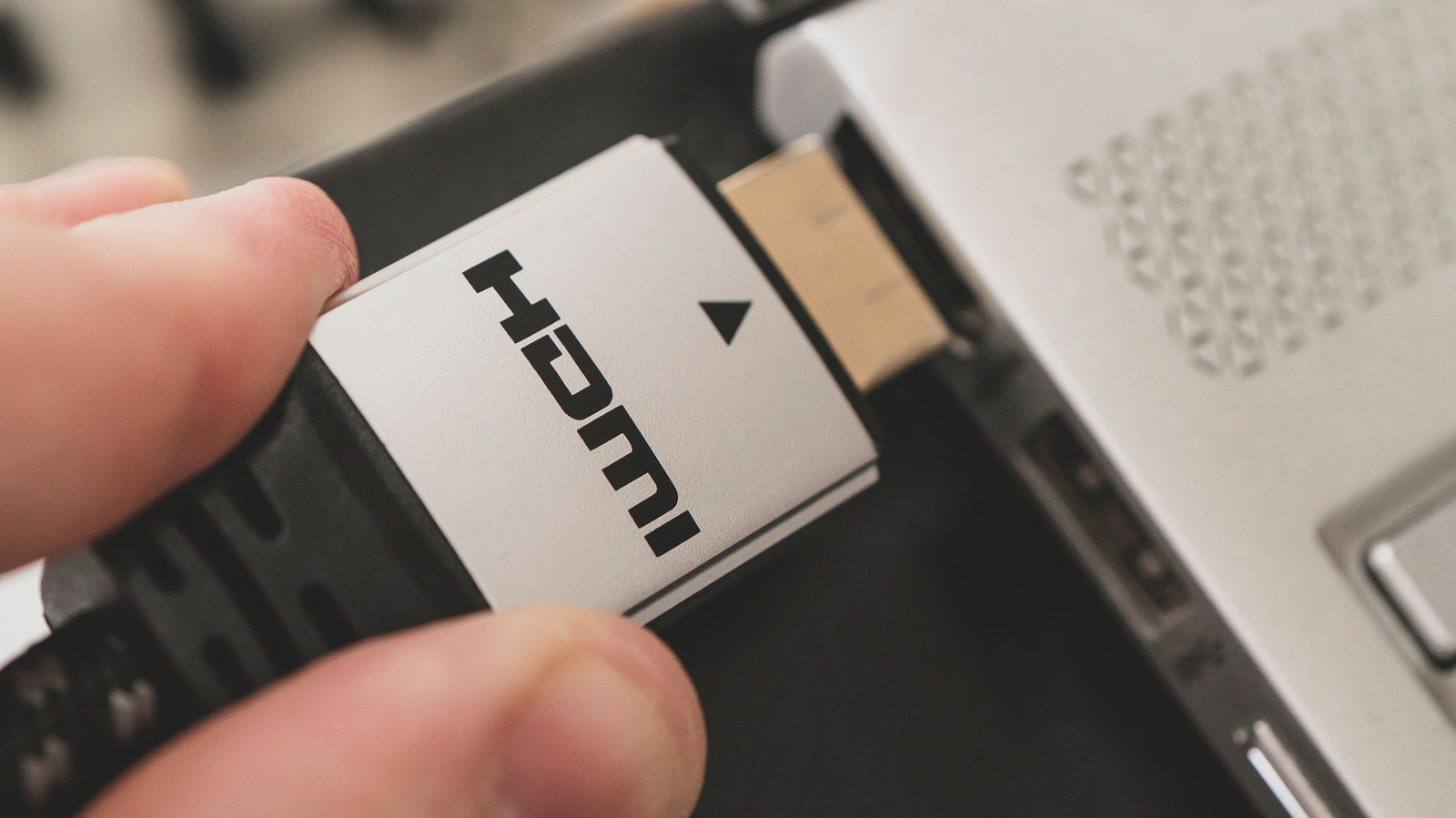
In June 2025, the HDMI Forum made an announcement that display tech enthusiasts had been awaiting. It announced key details of HDMI version 2.2 — the latest version of the HDMI standard — which has been in the works for almost a decade. A successor to the HDMI 2.1 interface released in 2017, this version is a massive upgrade over its predecessor. It boasts higher data transfer speeds, supports higher resolutions, and can handle much higher refresh rates as well.
Given that it's been over a year since the HDMI 2.2 specifications were first announced, enthusiasts have wondered as to when the first HDMI 2.2 devices would hit the market. Looks like we finally have some answers. According to Rob Tobias, CEO and President of HDMI Licensing Administrator, the first HDMI 2.2 devices could hit the market by 2027. Speaking on the sidelines of Computex 2026, Tobias added that manufacturers are currently testing new chips that will be the backbone of HDMI 2.2 tech. When HDMI 2.1 was released in 2017, it took over two years for the first compatible devices to be released. Tobias expects a similar timeframe for HDMI 2.2 devices as well, which explains the possible 2027 timeframe.
While he stopped short of revealing the types of HDMI 2.2 devices expected to release first, if historical precedent means anything, it is likely that these devices could be high-end TVs from players like Samsung and LG. It is also important to note that users will need to upgrade to a new HDMI cable — called the Ultra96 cable — to enjoy the higher resolutions, refresh rates, and data transfer speeds offered by HDMI 2.2.
The Evolution of HDMI Standards
It's been over two decades since the first version of HDMI was released. The technology — first introduced in 2002 — went on to become one of the most widely used digital interfaces to transmit high-quality video and audio, with an estimated 14 billion devices featuring the technology. HDMI has been through several upgrades throughout its 24-year lifespan. Beginning with HDMI 1.0 in 2002, there were 8 separate iterations of the HDMI 1 series, culminating with HDMI Version 1.4b in 2011. The year 2013 witnessed the dawn of the HDMI 2.0 standard, which has since then been replaced with HDMI 2.0a in 2015, HDMI 2.0b, in 2016, and HDMI 2.1 in 2017.
Despite undergoing a prolific series of updates between 2015 and 2017, the HDMI standard has remained rather unchanged for close to a decade, remaining stuck at HDMI 2.1 from 2017 to 2025. This wasn't entirely surprising given that HDMI 2.1 offers excellent transmission speeds (48.0 Gb/s), and supports high enough refresh rates to handle even the most demanding of video files in 2026. It supports high-resolution content (8K @60 Hz), and the introduction of the eARC standard meant users did not need to hunt for separate audio cables. Simply put, HDMI 2.1 remains relevant and highly usable to this day.
Nevertheless, the HDMI Forum did have to look to the future, which resulted in the arrival of HDMI 2.2. This version of HDMI has a much higher performance ceiling, with 2x the bandwidth (96 Gb/s), and higher resolution and refresh rate support (12K@120 and 16K@60). While not everyone may need HDMI 2.2 in the near future, expect it to go mainstream over the next decade.
Technical Breakthroughs in HDMI 2.2
The jump from 48 Gb/s to 96 Gb/s is not merely incremental; it represents a fundamental shift in what is possible with a single cable. This bandwidth doubling is achieved through improved signal modulation and advanced error correction technologies. The new standard also introduces support for Dynamic HDR metadata at higher bit depths, enabling more accurate color reproduction and contrast in demanding scenes. For professionals in video production and post-processing, HDMI 2.2's ability to handle uncompressed 12K resolution at 120 Hz will be a game-changer, allowing for real-time editing of ultra-high-definition content without the need for multiple data streams.
Another key improvement is the inclusion of a new Fixed Rate Link (FRL) mode that can operate at 48 Gb/s, 72 Gb/s, and 96 Gb/s, providing backward compatibility with existing HDMI 2.1 devices. However, to achieve the maximum 96 Gb/s, the new Ultra96 cable is mandatory. This cable features higher-grade shielding, thicker conductors, and optimized impedance matching to maintain signal integrity over longer distances. The HDMI Forum has also standardized a new connector design with improved locking mechanisms to prevent accidental disconnection, a common issue in high-vibration environments like gaming setups or professional studios.
Furthermore, HDMI 2.2 includes enhanced Audio Return Channel (eARC) capabilities, now supporting Dolby Atmos and DTS:X Pro with lossless audio up to 32 channels. This eliminates the need for separate audio cables in home theaters, simplifying installation and reducing clutter. For gamers, the new standard offers Variable Refresh Rate (VRR) and Auto Low Latency Mode (ALLM) with even tighter tolerances, ensuring smooth gameplay at frame rates exceeding 240 Hz at 4K resolution.
Market Implications and Adoption Timeline
The announcement by Rob Tobias at Computex 2026 indicates that chipset samples are already being tested by major manufacturers. Historically, the adoption of new HDMI standards follows a predictable pattern: first, high-end televisions and monitors appear in the luxury segment, followed by AV receivers, game consoles, and eventually budget devices. For HDMI 2.2, early adopters are likely to be professional-grade monitors aimed at video editors and medical imaging, where ultra-high resolution is critical. Consumer TVs from companies like Sony, LG, and Samsung could debut as early as 2027, with 8K and 12K models leading the charge.
The need for new cables poses a potential barrier. The Ultra96 cable is expected to be more expensive than current high-speed HDMI cables, potentially retailing for $30 to $50 for a 2-meter length. However, the HDMI Forum assures that the cable will be backward compatible, meaning users can still use older cables for HDMI 2.1 devices. Over time, as manufacturing processes mature, prices are likely to drop. The transition to HDMI 2.2 will also require new receiver chips in TVs and monitors, which could initially add $200 to $300 to the cost of a device.
In the broader context, HDMI 2.2 faces competition from DisplayPort 2.1, which already supports 80 Gb/s bandwidth (with UHBR 20) and is widely used in PC monitors. However, HDMI remains dominant in consumer electronics, especially in TVs, streaming devices, and game consoles. The 96 Gb/s ceiling of HDMI 2.2 gives it an edge for future-proofing, especially as 16K content becomes more feasible in the next decade. For now, the biggest challenge is content availability: most video is still produced in 4K or 8K, and 12K or 16K broadcasts are years away. Nevertheless, the HDMI Forum is betting that hardware will drive software adoption, just as it did with 4K and HDR.
Beyond consumer use, HDMI 2.2 has significant implications for virtual reality and augmented reality headsets. The higher bandwidth allows for uncompressed video streaming at 12K per eye, enabling lifelike visuals with minimal latency. Automotive displays, digital signage, and medical imaging are other sectors poised to benefit. The HDMI Forum has also hinted at support for Power over HDMI (PoE) in future iterations, but that feature is not included in version 2.2.
As manufacturers continue testing chips and developing prototypes, the countdown to 2027 begins. For tech enthusiasts, the wait may be long, but the payoff — a truly future-proof interface capable of handling the most demanding video and audio signals — makes it worth it. In the meantime, HDMI 2.1 remains a solid choice for current needs, but those planning a high-end home theater or professional studio setup should keep an eye on HDMI 2.2 developments.
Source: SlashGear News