

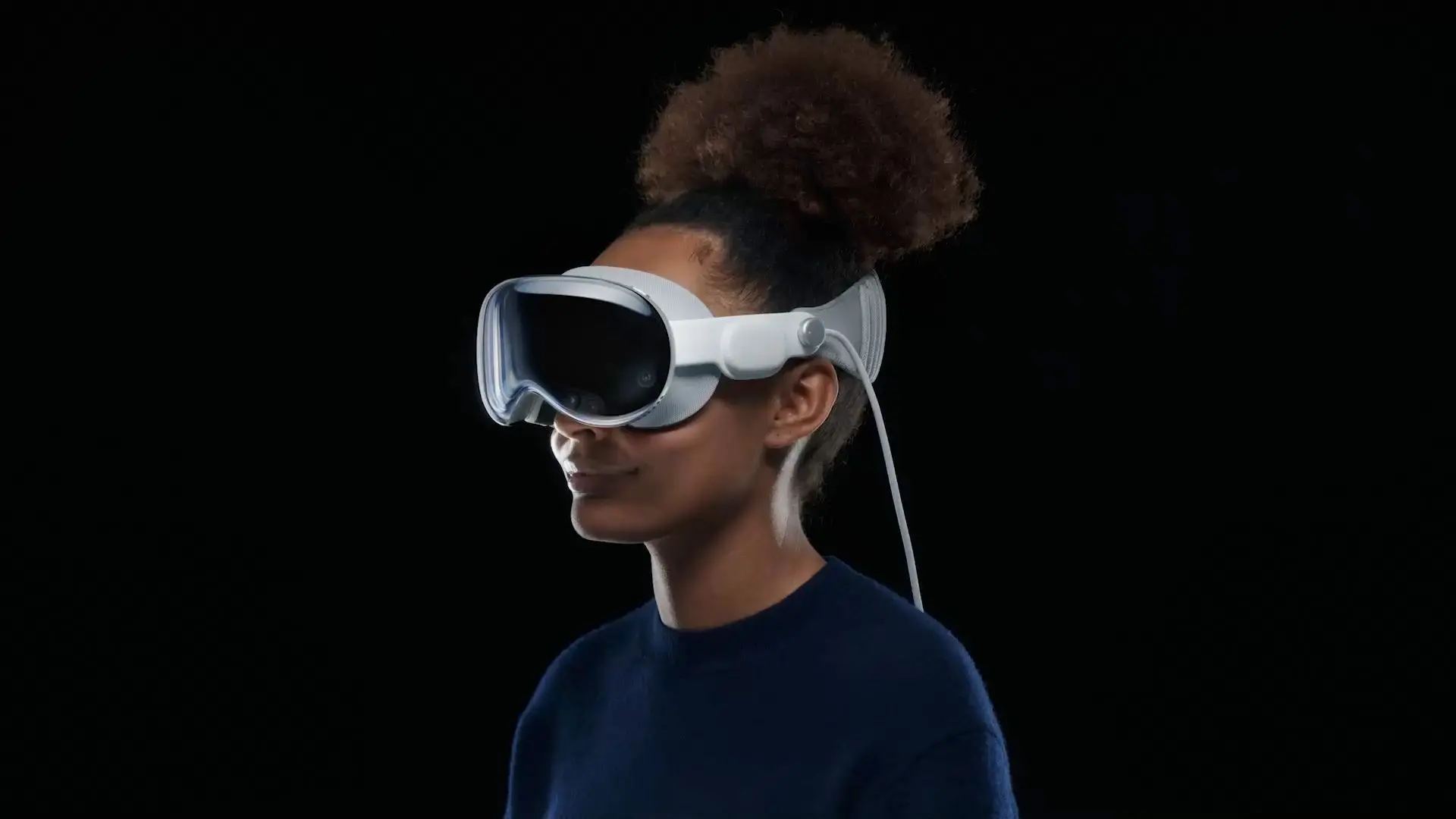
Apple Vision Pro is Apple's mixed-reality headset, described by the company as a spatial computer. It overlays augmented reality content on the outside world and can switch to fully immersive virtual environments. The first version arrived in February 2024, and Apple released an updated model with an M5 chip in October 2025. The M5 version brings a more comfortable band, faster performance, and a higher refresh rate, but the price remains high.
Key Facts at a Glance
- Price: starts at $3,700 for 256GB storage
- Launch: February 2024, with M5 refresh in October 2025
- Display: two micro-OLED panels with 23 million pixels
- Chip: M5 plus dedicated R1 sensor processor
- RAM: 16GB unified memory
- Storage: 256GB, 512GB, or 1TB
- Battery: 2.5 hours general use, 3 hours video playback
- Controls: eye tracking, hand gestures, voice commands
- Cameras: 12 cameras and five sensors
- Authentication: Optic ID iris scanning
Should You Buy the Vision Pro?
The $3,700 Vision Pro is prohibitively expensive for many consumers, and reviews have made it clear that it does not easily fit into an existing workflow for most people. Some users have even regretted purchasing the headset. The Vision Pro is great for watching movies, viewing 3D videos, and using as a display for a Mac.
At over 1.3 pounds, the Vision Pro is heavy and fatigue can set in quickly, but Apple improved comfort with the Dual Knit Band that launched alongside the M5 chip. There is also an external battery pack to contend with, and the headset is not easy to travel with, especially with Apple's dedicated Travel Case.
The Vision Pro is undoubtedly Apple's most technically advanced product and an incredible feat of engineering that is impressive when it is first viewed, but those considering a purchase should try it at the Apple Store and do a lot of research on what can be done with it before making a purchase. The Vision Pro is excellent for watching movies and consuming content, plus it can be used as a display for a Mac, but it has a limited number of apps and games.
Apple refreshed the Apple Vision Pro with an M5 chip in October 2025, which means now is a good time to buy. Another update is not expected for at least two years, and development on a next-generation headset is currently paused. Apple raised the price of the Vision Pro from $3,499 to $3,699 in June 2026 because of the ongoing global memory crisis.
How to Buy
The M5 Vision Pro is available for purchase from the Apple online store and Apple retail locations. It is available in Australia, Canada, China, France, Germany, Hong Kong, Japan, Korea, Taiwan, the U.K., the United Arab Emirates, and the United States.
Pricing starts at $3,700 for 256GB of storage space. The ordering process requires a Face ID scan to help customers determine the correct Light Seal and headband fit. Zeiss reading lenses for the Vision Pro cost an additional $99, while custom prescription lens inserts are priced at $149. A valid unexpired prescription from a U.S. eye care professional needs to be uploaded after purchase in order to get custom prescription lens inserts.
What's in the Box
The Vision Pro ships with a Dual Knit Band that comes in small, medium, or large. It also comes with a Light Seal, two Light Seal Cushions in different sizes, an Apple Vision Pro Cover for when the headset is not in use, a Polishing Cloth, a battery, a USB-C charging cable, and a USB-C power adapter.
No Trade-Ins
If you have an older M2 version of the Vision Pro, there is no option to trade it in for the M5 model. Apple is not accepting Vision Pro trade-ins.
Vision Pro Reviews
Reviewers were impressed with the Dual Knit Band that's included with the M5 Vision Pro, and did indeed find it more comfortable when wearing the headset for more than an hour or two. It cuts down on pressure on the face and neck strain, but while weight is more balanced, it is still noticeable.
As for performance, the M5 does seem to make a difference compared to the prior-generation M2 chip. Several reviewers said that performance was more consistent, with no lag and stuttering. It's clear that the Vision Pro is faster at tasks like generating a spatial persona, plus it is able to render 10 percent more pixels so content appears sharper and more in focus.
Reviewers thought that the 10 percent increase and added support for 120Hz refresh rates led to more crisp and smooth visuals, though it isn't a dramatic difference.
How It Works
Apple Vision Pro is a 'mixed reality' headset, meaning it can display both virtual and augmented reality content. It is not like augmented reality glasses, however, as it is designed to completely cover the eyes and block out all of your surroundings.
Apple is using exterior and interior cameras for the augmented reality component of the device. The cameras are able to map the space around you and project the real world back to you, so though you're not actually looking at what's around you using see-through glasses, you are effectively seeing an accurate picture of your real world environment.
With this capability, Apple can show you 3D windows, objects, and content in your actual space, or the cameras can be turned off to shut out the world to provide an entirely virtual setting. Apple is focusing on the headset's ability to allow for working, content consumption, gaming, communication and other activities to be done 'anywhere' with just the Vision Pro.
Design and Comfort
Vision Pro is Apple's wearable 'spatial computing' device, and while Apple does not refer to it as a headset, that's exactly what it is. The Apple Vision Pro is worn over the head, and it is a virtual/augmented reality headset similar to the PlayStation VR or Meta Quest.
Design wise, the Vision Pro looks similar to a pair of ski goggles, albeit high-end goggles. It features a laminated glass front, which Apple says was 'three-dimensionally formed.' The glass is attached to a curved aluminum alloy frame that wraps around the face. The headset is only available in silver with matching gray Light Seals and bands.
The frame connects magnetically to a Light Seal that sits on the face, and Apple offers the Light Seal in a range of sizes and shapes to fit different faces. A tight fit with the Light Seal is essential for blocking out light and proper operation of the headset. Apple designed the Light Seal to be flexible so that it can conform to individual face shapes. An ill-fitting Light Seal causes the Vision Pro display to be blurry and it allows light to creep in.
At the side of the headset, there are two audio straps that are equipped with speakers that support spatial audio. The audio straps connect to a 3D braided fabric Dual Knit Band that secures the headset to the top and back of the head, with an adjustable dial for tightening it up for a customizable fit. The headband is detachable so users can swap in different sizes, and it comes in small, medium, and large.
Apple launched the softer, more comfortable Dual Knit Band with the M5 Vision Pro. The Dual Knit Band has two 3D-knitted straps, one that fits behind the head and one that fits at the top of the head. The two bands are knitted as a single piece for a dual-rib structure that Apple says provides cushioning, breathability, and stretch. The original version of the Vision Pro came with a single strap Solo Knit Band and the Dual Solo Loop that did not feature comfortable knit material.
The lower strap has flexible fabric ribs with tungsten inserts to provide a counterweight for extra comfort and stability compared to the prior Solo Knit Band and Dual Solo Loop. The Dual Knit Band comes with the M5 Vision Pro, but M2 Vision Pro users can purchase it separately for $99.
Physical controls include a Digital Crown at the top that changes your level of 'immersion' and to show you more or less of your real world surroundings through 'Environments,' and a top button that serves as a camera button for capturing 3D 'spatial' videos and photos.
On the left side of the headset, there is a space to attach a braided cable that provides power to the device. The round charging puck looks like an Apple Watch charging puck, but it clicks into the headset securely with a rotation gesture. The charging cable attaches to either an external battery pack worn at the waist or a power adapter connected to the wall.
Display
Apple Vision Pro is equipped with two custom micro-OLED displays that provide a total of 23 million pixels, which Apple says is 'more pixels than a 4K TV.' Display quality is improved in the M5 version of the Vision Pro thanks to increased processing power. The Vision Pro with M5 is able to render 10 percent more pixels for more detailed visuals with crisper text. Refresh rate has also been increased to up to 120Hz for reduced motion blur when users look at their physical surroundings, and a smoother experience when connecting the Vision Pro to a Mac. The prior Vision Pro was limited to 90Hz.
There's also an external 'EyeSight' display that shows the headset wearer's eyes to the people in the room around them. The feature is designed to allow people to know if the headset wearer is using a less immersive augmented reality mode or a fully immersive virtual reality mode. The eye display that is shown on the exterior display comes from an interior camera that is monitoring the wearer's eyes. It can also alert people when you are recording video with the external camera.
Lens Inserts
Apple Vision Pro customers who wear glasses can order Zeiss Optical inserts with their prescription. Zeiss lenses are priced at $149 for a custom prescription, or $99 for readers. The lenses attach magnetically to the displays inside the headset, and can be engraved on the edge. Zeiss lenses are available for prescriptions within -11.00D to +6.75D, and prescriptions with prisms are not supported at this time. Vision Pro can be used with soft contacts, but it is not compatible with hard contact lenses.
Cameras and Sensors
Apple Vision Pro includes 12 cameras and five sensors for monitoring hand gestures and mapping the external environment. Two of the cameras transmit more than a billion pixels per second to the display to depict the real world around the wearer when using augmented reality mode, while the others are used for head tracking, hand tracking, and real-time 3D mapping.
Infrared flood illuminators enhance hand tracking in low-light conditions, and LiDAR depth sensors determine the size and location of objects in the room around you. Four infrared cameras and LED lights are inside the headset for eye tracking purposes. With this technology, the Vision Pro is able to tell exactly where the wearer is looking for navigation purposes.
Navigation
There are no physical controls for the Vision Pro. Navigation is done through eye movements, hand gestures, and voice-based commands. In visionOS, for example, you can highlight an element like an app icon by looking at it, using a quick hand gesture to launch the app. Bluetooth keyboards, mice, trackpads, and game controllers can be connected to Vision Pro as an alternative navigation method, though these are mainly designed to be used with a connection to the Mac and for Apple Arcade games.
Optic ID
The infrared cameras and LED lights inside the Vision Pro are used for a security feature called Optic ID. Optic ID is similar to Touch ID or Face ID, but it uses iris scanning instead of a facial scan or a fingerprint scan. Each person has a unique iris pattern, which the headset is able to detect to keep sensitive data on the headset secure. Optic ID can be used like Face ID for unlocking the device, authenticating purchases, and as a password alternative.
3D Camera
Apple included an exterior camera that is able to capture 3D video and 3D photos that are viewable in 3D on the Vision Pro. Apple says that these are like reliving a memory in person because of the 'incredible depth' that's available. The camera gives a clear indicator when recording is turned on so that the headset cannot be used to secretly record video.
Audio
There are speakers on either side of the headset, with the speakers built into the straps that are connected to the frame. The speakers feature dual-driver audio pods that are positioned next to each ear, and they are able to analyze a room's acoustic properties to adapt the sound to match the space. The speakers support spatial audio for an immersive surround sound experience, plus there are also six microphones for phone calls, video calls, and voice commands.
The Apple Vision Pro pairs with the AirPods for a superior audio experience, and the USB-C AirPods Pro 2 released in September 2023 support 20-bit, 48 kHz lossless audio with ultra-low latency when connected to the Vision Pro. The AirPods Pro 3 also support this feature.
Connectivity
The Vision Pro supports Wi-Fi 6, which operates on the 2.4GHz and 5GHz bands. It does not include support for the faster Wi-Fi 6E specification that is compatible with the 6GHz band.
Processors and RAM
The Vision Pro is equipped with the M5 chip, which is built using third-generation 3-nanometer technology. It has a 10-core CPU and a 10-core GPU. The 10-core CPU includes six efficiency cores and four performance cores, providing faster experiences throughout the system. Apps and widgets load faster, and web browsing is more responsive. According to Apple, the M5 has the 'world's fastest CPU core.'
Each M5 GPU core features a Neural Accelerator, improving the speeds of GPU-based AI workloads. Third-generation ray-tracing, second-generation dynamic caching, enhanced shader cores, and improved graphic capabilities are included for detailed lighting, shadows, and reflections in apps and games. There's an improved 16-core Neural engine that boosts speeds for built-in AI-powered features up to 50 percent, and provides up to 2 times faster performance for third-party apps compared to the M2 chip.
Apple boosted unified memory bandwidth to 153GB/s. Unified memory architecture allows the entire chip to use a single pool of memory for running AI models on-device, improving multithreaded performance in apps, boosting GPU performance in creative apps and games, and more. With the M5 chip, the Vision Pro is able to render 10 percent more pixels with the micro-OLED displays, and it can handle refresh rates up to 120Hz for crisper details, more fluid display performance, and reduced motion blur.
The M5 works alongside the R1 chip. The R1 is responsible for all of the information coming from the cameras, sensors, and microphones. Apple says that it can stream images to the displays within 12 milliseconds, providing a 'virtually lag-free' view of the world. There is a thermal system inside the Vision Pro that is designed to quietly move air through the headset to control heat and optimize performance.
RAM and Storage
The Vision Pro has 16GB RAM. The entry-level Vision Pro is equipped with 256GB of storage space, but Apple also offers upgraded options with 512GB and 1TB of storage.
Battery Life
The M5 Vision Pro offers improved battery life, running for up to three hours when watching video. It lasts for up to 2.5 hours during 'general' use, which is a half hour longer than the M2 Vision Pro. Battery packs can be swapped out for additional power on the go, but the device ships with a single battery pack. When plugged in to a power adapter, the Vision Pro can run all day.
visionOS
visionOS is the operating system that runs on the Vision Pro headset. It features a full three-dimensional interface with a Home View, apps, and interface elements that are able to react dynamically to natural light and shadow in the user's surroundings. visionOS is navigated using eye movements, hand gestures, and voice control. visionOS apps can be placed anywhere in virtual space visible to the user, and they can be resized to be ultra large or small. App windows can be stacked on one another, arranged around a room, and resized. There is a virtual keyboard that can be used with air typing, but accessories like game controllers, keyboards, trackpads, and mice can also be connected.
The level of immersion in visionOS is adjustable. Users can either see their content in their actual surroundings through the Apple Vision Pro's cameras, or a virtual 'Environment' can make the real world fade away. Immersion can be adjusted with the Digital Crown. For the headset wearer, visionOS creates a Persona or digital representation that reflects face and hand movements in real time, with the Persona used in FaceTime and other video apps.
With content apps like Apple TV+, visionOS can display TV shows and movies on a personal movie screen that feels 100 feet wide, plus visionOS offers Apple Immersive Videos that are 180-degree high-resolution recordings. visionOS supports Spatial Audio through the Apple Vision Pro's speakers. visionOS integrates with the Mac to allow the Apple Vision Pro to serve as a display for a Mac. The Mac's screen shows up in the virtual space provided by visionOS for a private, portable 4K display.
There's a Travel Mode for using Vision Pro on a plane, car, or train, as well as a dedicated Guest Mode for letting other people try the Vision Pro.
visionOS 26 and visionOS 27
visionOS 26 was released in September 2025, adding persistent widgets that can be integrated into the space around you, just like apps. You can put a widget anywhere, and it stays put when you move around or restart your Vision Pro. Apps stay put in visionOS 26 too. Personas feature more lifelike hair, eyelashes, complexion, and movement, plus when creating a persona, there are more glasses styles and materials to choose from. You can share Vision Pro experiences with other people who are using Vision Pro in the same room with you, there's an option to view your iPhone while wearing Vision Pro, and there's a Jupiter Environment to experience.
visionOS 27 is the latest version of visionOS, coming to the Vision Pro in September. It includes Siri AI, an overhauled version of Siri that's much smarter and more capable than before. Siri AI uses generative AI models and it performs more like ChatGPT or Claude than the prior version of Siri. Siri can hold full back-and-forth conversations, and it has access to your personal data so it knows more about you and can complete complex tasks. In visionOS 27, Siri appears as a floating, 3D bubble that you can put anywhere in your space. It stays pinned in place ready to answer questions, and to interact, you just look at Siri and speak.
visionOS 27 also includes Visual Intelligence, and you can ask Siri about anything that you're looking at, whether it's something physical in the room or something digital. There is a Siri app where you can revisit past conversations or start a new conversation. On the M5 Vision Pro, you can set a custom voice for Siri, with personalized pace and expressivity. Image Playground on Vision Pro can generate images in any style, including photorealistic. Safari can automatically organize bookmarks and Reading List by topic. The Passwords app uses AI to change weak and compromised passwords for you, upgrading them to strong passwords. The Freeform app lets you pull items off your board and arrange them in front of you in your space, plus it supports collaborative folders for sharing multiple boards.
With Dwell Control, visionOS 27 supports making selections with your eyes with a selection marker. Screen Recordings can be captured in an unfoveated format with full edge-to-edge sharpness for sharing spatial experiences. The Vision Pro can be used to transform panoramas into 3D panoramas that can be set as a personal environment. Apple also added a new Thórsmörk Environment featuring an Icelandic aurora.
Medical Warnings
Apple says that there are certain medical conditions that could be exacerbated by the Vision Pro headset. Customers with these conditions should consult with a healthcare professional before using the Vision Pro, as the headset could aggravate symptoms. These include heart conditions, migraines or chronic headaches, dizziness or vertigo, eye or vision conditions, psychological conditions, inner ear conditions, history of dry eyes, itchiness or swelling of the eyelids, skin allergies or sensitivities, seizures, and balance or gait conditions. Apple adds that pregnant individuals should exercise additional caution when using the Vision Pro due to an increased risk of nausea or loss of balance. Apple also warns that the Vision Pro and its battery pack could interfere with nearby electronics, including cardiac pacemakers, hearing aids, and defibrillators.
What's Next for the Vision Pro
Apple is designing 'smart glasses' that are similar to the Meta Ray-Bans. The glasses will not have a display, but will be equipped with speakers for audio playback, microphones for recording video and for calls, and a camera for images and feeding data to AI. Apple is said to be pausing work on the next Vision Pro in order to focus on the glasses. Apple plans to have multiple frame and temple material options for a customized look, and there will be a built-in AI assistant. Kuo says that Apple will launch the glasses in 2027, but Gurman believes that Apple will introduce the smart glasses in late 2026.
Apple is allegedly continuing to develop new technologies and materials with the eventual goal of releasing a cheaper, lighter enclosed headset. No new version of the Vision Pro is in active development, and it will be at least two years before there is a new model, if not longer. A new Vision Pro is unlikely to come out until late 2028 or 2029, according to Bloomberg's Mark Gurman.
Apple analyst Ming-Chi Kuo does not believe Apple is working on a new headset. Kuo says there are only two smart glasses products in development, including the AI smart glasses that Apple is creating to rival the Meta Ray-Bans and a display-equipped set of AR smart glasses. 'I think removing the Vision Pro line was the right call, as Apple shifts resources toward smart glasses with greater mass-market potential,' he wrote.
Apple was working on augmented reality smart glasses that connected to the Mac for power, but work on the project was halted in January 2025. Apple initially wanted the glasses to run off of the iPhone, but it was not powerful enough and the glasses drained too much battery. Apple transitioned to using the Mac instead, but ultimately executives did not think the Mac-connected glasses would work out. Apple glasses continue to be one of Tim Cook's top priorities, and he is said to be 'hell bent' on bringing the technology to market.
In the future, the Vision Pro could be used to diagnose and treat mental health issues. Apple has tested using the Vision Pro to track a user's facial expressions to detect depression, anxiety, stress, post-traumatic stress disorder (PTSD), and other issues. Apple believes that eye-tracking, pupil dilation, and external cameras can measure a person's 'affect,' a psychological term that refers to how an individual expresses emotions. When a problem is detected, the Vision Pro could play relevant images and sounds to improve the wearer's mental state. Apple has also discussed using the eye-tracking cameras to detect swelling in the blood vessels of the eyes, an early sign of heart failure.
Apple analyst Ming-Chi Kuo believes that Apple could be planning augmented reality 'contact lenses' that could launch sometime in the 2030s. According to Kuo, the lenses will bring electronics from the era of 'visible computing' to 'invisible computing.' There is 'no visibility' for the contact lenses at the current time, and it's not a guaranteed product that Apple will develop.
Apple Vision Pro remains a remarkable piece of technology, offering a glimpse into the future of spatial computing. With its high price, heavy design, and limited app ecosystem, it is still a product for early adopters and enthusiasts. The M5 update improves comfort and performance, but the overall value proposition depends on how much you value immersive media, virtual displays, and Apple's vision for computing. The coming years will show whether smart glasses or a cheaper headset can bring this technology to a broader audience.
Source: MacRumors News